Sunday, April 28, 2019

Positive!

I don't know how often you heard the command: "Don't be negative!", I heard it too often While I don't mind the idea of "being positive", tackling challenges with an optimistic mind set, "Don't be negative" proves to be a contradiction in terms. It takes a double negative to say this, so anyone using it just demands to "Do as I say, not as I do".

So i while appreciate finding the good within the bad, "Don't be negative!" seems like the war cry of those playing the old-fashioned game of domination while preaching cooperation. I heard it a lot while pointing out things that didn't actually work out.

When I studied psychology, I came across an interesting finding. Those diagnosed to be "depressed", often showed a much more realistic attitude to their environment, instead of a positive bias. Now, that might indicate that I'm probably a bit depressed, however, I still think it's much better in a working environment to assess situations realistically than "positively biased".

Luckily, I changed the place of work. I remember one guy I my last working environment inundating with me the mantra "Don't be negative!" while flicking his cigarette butt into the front yard patch which I converted from a public dumping ground into a patch full of usable plants. Hold on a second, Ollie, do you really think it's appropriate to give me a bad time while you're not caring a bit about your immediate environment?

Get me right (doesn't that much better than the double negative: Don't get me wrong?), I like working out things okay. I don't play the blame game, which means if what has to be done can be done I'm in a happy space. Humans seem to be thriving when they manage to solve problems, yet it seems like a minority of people seems only happy when they can create problems for others. Like claiming "Don't be negative!", when someone points out that sailing to another island needs boat, and the one around is leaking.

My memory of past lives certainly sucks. Again, I'm realistic here, not delusional in the way to claim that when I've been pharaoh everyone else had a good life, how the fuck did it all go to shit? Quite obviously, if the Egyptians created an ideal society for all, it hasn't survived. Nevertheless, the pyramids help us to remember that knowledge and craftmanship were probably more advanced than today. If our contemporary society can't build something that has been build thousands of years ago, it's quite obvious that we aren't the most advanced society of this planet.

As mentioned before, pointing out that things don't work out doesn't mean being a "negative nanny". If you want to go on a road trip, and your car doe clue what they are has highest priority. Preventing anyone from fixing the most urgent problem, because it's "negative" to even mention that the car doesn't work, demonstrates a highly delusional mind set.

However, it seems so much easier to make someone feel bad about pointing out the obvious than solving an actual problem. The gratification derived from some other person's emotional distress might not trump the one derived from solving a problem, however, it offers immediate happiness, the most valuable currency in our deeply dysfunctional times. In my experience, no matter how eager you try to ignore a challenge, it doesn't make it go away. Feel free to call me a "negative nanny " for pointing out the obvious.

It seems futile to point out that "Don't be negative" uses a double negative to bring its message home. If someone deliberately uses this phrase, it's to make them feel better on your expense in a social context. It creates a no-win situation for you, and you're probably better off to avoid those people than trying to make the situation work. Most likely, anything you mention in your defence will be construed against you.

Let's end this on a positive note. If you happen to encounter people who label you as "negative", they most likely have no fucking clue what they are talking about. They need support which they won't accept from you, and often haven't even realised how dearly they need it. Don't let their delusional self confidence bring you down - that's what their "Don't be negative" rant is all about.


Thursday, December 20, 2018

Life and death

You never know when the reaper calls you. Sometimes, it's a bit more obvious. When my father died, he just went to the hospital one weekend, and on Monday I heard about him passing away. When my brother died of lung cancer, it was less sudden. I had months of denial until I realised how deadly lung cancer is. Luckily, I had a chance to see him before it happened, to have the chats needed in the moments of lucidity while he was sedated with morphine.

Both of them didn't make it to 50, and appeared in my dreams afterwards. While I decided not to worry about my own death, the process of dying, potentially dragging on for months, doesn't sound pleasant at all. I was on the other of the globe while my mother lost her battle against cancer and chemotherapy, witnessing on the phone the turn from optimism to giving up.

Our society doesn't appreciate death, and sometimes just admitting that some of my relatives exited this existence made me feel like an outcast. I didn't really celebrated my 50th birthday much, although I cherished somehow staying for longer in this existence than two out of three of my closest male relatives. Average life expectation doesn't mean much, as millions of people make it up. Individual lives end at some point, below or above this average.

The first funeral I attended since decades brought my own strange relation to death back home, while at the same time aligning it more with my firm believe in reincarnation. We danced, and drank, and had a massive party, to celebrate the member in our midst who was gone. Yet I didn't yet dare to talk his immediate family how they coped with the hole ripped into their lives since then.

Today I found out that the best friend I had in Europe kicked the bucket. He contacted me less than half a year ago to notify me of his battle of cancer, and our last conversations were online. He also appeared in my dreams, but I missed the opportunity to hear his voice before it happened. He died just a day after I found out that my favourite niece was diagnosed with lung cancer.

My niece is in her mid thirties, and maybe the only person I witnessed from birth to adulthood. The last time in went back to Europe was mainly to say hello to her first daughter, as I knew that I wanted to stay in Australia for good. I vaguely remember seeing some bits and pieces I gave her before leaving Germany back then.

Call me old-fashioned, but I don't value "remote" communication, be it phone or social media, as much as face to face. Back when only landline phones were used, I knew how much one could fake it. I still felt compelled to phone my niece, and was surprised about the familiarity of her voice, and how connected I felt while hearing about her journey.

She sent me link to her instagram after our conversation, and that blew me away. She memed her fight against her cancer, which allowed me to see a recent photo. It took me some days to check her account (I'm over facebook, which owns instagram, and no longer much into "social" media). What I found, though, filled me with pride. When I left my home country, I gave her some things I didn't want to throw away.

Seeing these items being posted online, more than decade later than when I left them, made me sentimental. My mother inculcated the importance of family into me, so while my niece grew up, I always intended to influence her in a positive way. I gave her books and mixtapes, lend an ear to hear about her struggles and dreams, wanting to be the crazy uncle supporting her to become the best she wants to be, telling her wild stories her parents probably wouldn't have approved.

It breaks my heart seeing her fighting a potentially lethal cancer. Her artwork, like most visual art, offers an insight to her soul. I don't even know when she started drawing, but it looks like her art made it onto t-shirts and tote bags, and to prominent places in her home. As I love immediacy of interaction, I lost track about someone my heart is connected to. Yet losing someone until the next reincarnation takes more than I take at he moment.

Tuesday, December 18, 2018

Even more feral

Social media, the modern battlefield for consumerists. My former workplace still fights hards for them valuable google reviews, and since the first comment of an unhappy neighbour, which accidentally is my house mate, the number of reviews has increased tenfold.

Honestly, I'd love to put it all behind. Due to utter stupidity on my side, I got confronted with this story again. And while I don't like mudslinging, I appreciate honest feedback. About less than a week ago, I heard about the next rallying call to rescue the reputation of this company, and found about 30 positive reviews floating in in just one evening.

As those reviews remain, I save myself from the copy and paste job of praising the product, its maker, the staff, the environmental highfalutin and so on. Marketing works, and most people taste the image of a product, and not its ingredients. My palate has adapted, though, to the nuances of this fermented product. Other frequent consumers, not being inundated by marketing, also agree that a potentially healthy drink turned into a sugary soft drink.

As I haven't sampled other brands lately, I can't assess how "real" the product from this company tastes in comparison to its competitors. The homebrew I had some months sets the standard of what I consider the real deal, and neither bottles nor kegs of my former employer get close. Anyway, while I'm cautious to prevent to name names, I'm certain if this blog is found it will be used against me.

Before the flood of good reviews came in, customers of the online shop reacted. Viki wrote:
"$19.95 for a ***** and I got two little pieces that didn't do anything.  Shopped on Gumtree and got a large health ***** for $10 that is going gangbusters." Charles commented:
"VEGAN RIP OFF This is the smallest ******** I have ever seen for the price!!! I don't even have a carbon footprint I got but stomped on with this one...  NEVER AGAIN ***..:( :( :( :("

Now, as these reviews refer to the actual product, and not how well the company gets along with its neighbours, it's probably hard to flag this feedback as "inappropriate". The majority of comments I quoted in the first part of this saga have gone by now, although I saw some reappearing temporarily. No idea whether the removed feedback stills gets into the average which now stands at 4.3 stars.

Even though I didn't want to, let's quote a five star review from the night of upvoting, as it presents the mixed approach of selling product and "community engagement". Gav wrote: "awesome brews and a real hub for community. i would love to see them host way more events at their brewery with lots of sustainable tunes to bring happiness to all of Brunswick. Could only be better if the tunes were loud enough to hear it from my place !"

Dear Gav, just move into one of the about twenty or so properties close enough. It's just, those people living here already for decades don't seem to share your enthusiasm. Paul steps in for his mom, who most likely doesn't engage on social media. "Every time I visit my mother all I can hear is horrible techno music coming from down the street. She will not open a window or even venture out into her beloved garden because of these disrespectful people.  techno music all day and then live bands on the weekends blasting out onto the street. She can't move. Over 40 years in her home and some tool is trying to drive her and her neighbours out. Respect your neighbours. There is no need for your music to be played so loud that all can hear it down the street. You do not realise what you are doing to the mental state of people who just want to get by. please consider."

I did the emphasis, for good reasons. I remember a neighbour coming into the warehouse stating something similar - that the sounds coming from the warehouse were meant to drive him out of his home. Unsurprisingly, when I mentioned today that I considered some of the negative feedback coming genuinely from real existing neighbours, I was again blamed for not convincing my housemate to withdraw her comment.

Carl sounds like someone who visited the place which once was flagged as "HQ". He writes: "Scary people. Unfriendly. Unclean premises." As I experienced quite different moods while working there, and various characters as visitors or extreme short-term staff, I have no difficulty imagining getting such an impression on a first visit. After all, I spend lots of time, especially when I had the hunch that things aren't working out the way I envisaged, in maintaining the front yard to create a pleasant impression.

I have to admit, the last quote might actually been inspired by social media sympathy, and not by the unique experience this business offer. Sally wrote: "A lot of great reviews is a very short period of time, no doubt most of them are just rubbish reviews designed to boost your rating, seems they have no problems criticizing people but when people do it to them they throw a tantrum like a bunch of 5 year old's, man up you bunch of pansies or go back to Healesville.

Pluggers review of this sh--t hole is the best and funniest I have read in a long time, need to put this one up on twitter, love the writing on board out the front by the way LOL"

Unfortunately, I haven't found pluggers review, I could do with some funny stuff while I'm confronted with lots of challenges. Telling this story provides me with some relief after a real life encounter with this severe storm in a teacup. I got reminded today to pick my team - which is ridiculous as life isn't a competition. I'm with team humanity.

Since I have left facebook I'm no longer exposed to vicious online battles, which usually exceeds how most people would interact in real life, even in conflict. I walked away from a work environment with an extremely volatile boss, as I don't believe in the "my way or the highway" mythos for lasting cooperation. I worked enough with change management systems to realise that individuals resisting to change themselves will not change anything around them for the better.

I might have burned a bridge, but sometimes bridges connect fertile grounds to wasteland.

Thursday, November 01, 2018

Going feral

While I was still working in the distribution warehouse next door, I tended the front yard garden for pleasure and as immediate therapy. Digging my hands into the soil, watching the variety of plants flowering, growing and attracting bees helped me to cope with a boss who seemed to miss the good old times of feudalism. Gardening combines the pleasures of immediate and delayed gratification. Picking a tomato or passion fruit, munching on some fresh parsley, mint or pineapple sage gives a hit of pleasure straight away, establishing some new plant in the mixture and waiting for it to thrive works on delayed gratification.

Pottering about the front yard also provided a great opportunity to get in touch with the neighbourhood, invite them to help themselves to some fresh produce, and have a friendly yarn about what else goes on in the unmarked yet busy place. I intended to create an appealing space, mainly to balance the never ending disorganised chaos which still typifies the remainder of the space.

After all, the company hiding in this massive warehouse markets itself as sustainable operation, engaged in saving the planet and community building. So converting a trashy bit of green strip into a lovely, thriving patch of greenery felt like the right thing to do. Having no pet myself, and believing the marketing spiel kept me on the ball creating a good first impression for visitors fitting the bill of the way the company, or rather its founder and boss, present themselves.

The neighbourhood undergoes quite some massive changes due to gentrification, but most people I got to know while living here where those in for the long haul. I sure noticed some faces which moved into some of the new developments which sprung up lately, yet most of those engaging as neighbours might stay for longer than me. Not only did I quit working next door, our house will be sold soon which means I have to move on. That's another story, which hopefully will have a happy ending.

What a sight

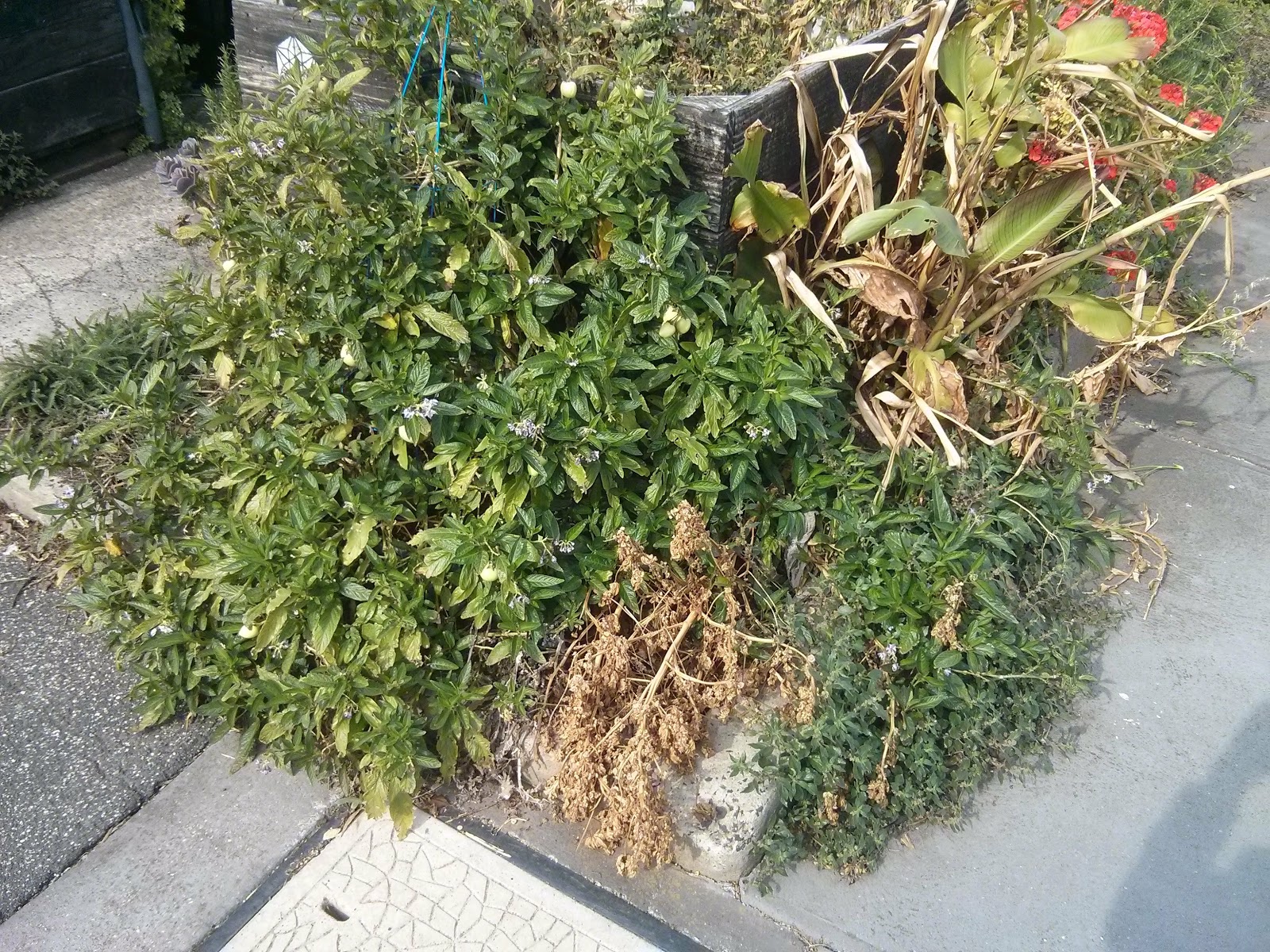
Gardens need tending, even if they have been set up with some permaculture ideas. The mild climate means that any spot which can grow something will be taken over by abundant weeds floating around. The rosemary, which survived probably already for a decade in the front yard. might need no help surviving, but besides this, things go pretty wild. The ivy growing along the fence to the neighbouring property will soon shade out everything beneath it, the passion flower is about to take over the pineapple sage, the ground covering succulent certainly stopped the comfrey from brandishing the abundance of purple flowers which attracted many bees last year.

While the patch isn't that big, it would take probably a day or two of pruning, weeding and mulching to get it back into a presentable and pleasant state. Of course, without caring about the more thirsty plants, a single intervention would probably just help for a month or so, but then, my time here is limited. And it seems like my former boss cares more about his social media image than the impression his place of business gives.

Feral and uncared


My offer to improve the first impression about his space were declined, mainly because of a ridiculous grief over my house mates dislike about the frequent use of the warehouse as entertainment place. A single one star review of his business sparked a conflict which nearly led to mutual intervention orders. While I did my best to remain neutral, I'm now blamed not for bringing my housos in line with his demands, and have to suffer from minor irrelevant consequences of his wrath.

The care about the real life impressions of a feral front yard reflects his care about the "community" he's trying to build. Being present and approachable in front of the warehouse meant that neighbours approached me, but not everybody in earshot of his enterprise is willing to show their dismay about the noise pollution coming from his space. At least not in person. After all, it takes some courage to rock up in the middle of a night to tell a bunch of pissed people that you'd like to have some peace and quiet late at night.

My housemate approached the ongoing noise pollution in a reasonable way, trying to engage the people in a face to face conversation and asking to tone it down. After some unpleasant (and later quite intimidating) responses, she decided to leave a one star rating with the comment: "Would give zero stars if possible." That's when things started to escalate, luckily not to the level of physical violence.

As a single review is obviously capable of single-handedly bringing down an entire business, my former boss knocked fiercer than police on our door, and took about a minute to lose his shit, demanding to remove this review, or else... We managed to ask him to leave and take his temper tantrum with him. As response, he used the A-board, often illegally (without council permit) placed on the pavement, to leave a message: "My neighbour doesn't like music and writes negative reviews on social media. He now gets a concert everyday until he deletes his review. Requests? @nameomittedcozYoucanresearchifyouwantto"

That happened about a month ago, and while I had some relatively normal conversations with him in the meantime, I noticed the grudge he still held today when offering some gardening services. I was surprised, mainly because I had no idea about the other social media stuff which happened since then. He complained bitterly on facebook about the uptight neighbours trying to limit his "right to party" whenever he wants to, and begged his abundant fb followers to leave positive reviews of his business.

I admit, as immediate neighbour I got sometimes annoyed by the random party noises coming from next door, and even while still working there, I sometimes called/texted asking to tone the noise down. In real life conversation, I suggested sound-proofing, as I was certain that our house couldn't be the only one affected. Which seemed an outrageous suggestion, because "all the neighbours love him, just our house causes trouble".

So when I checked out the google reviews again today, I couldn't help but revel in a bit of schadenfreude. When my housemate left her review, the company had maybe a dozen reviews, the oldest from 2 years ago. When I was working there, I served maybe about 100 people in person, dealing with 1,000s of mail orders. Most people didn't bother with a review, and I guess most people didn't check it to decide whether they would come or not.

Now it's a whopping 54 reviews, not even half as much as a Cafe in the same street which opened a couple of years ago. Unsurprisingly, most of them happened about a month ago, some of them explicitly referring about the nasty neighbours. Niall wrote: "Ignore all these 1 star reviews! **** **** ***** is the best! These immature bully boy tactics because a disgruntled man-baby doesn’t like live music! Wow! Support local, listen to loud music! And number 1 allways love! Not hate!" While he might have checked in this year, I haven't seen him in the neighbourhood for a long time, so I guess his, and his girl friends review reflect facebook solidarity.

Another item of this kind of solidarity: "These guys ran a fundraiser for my friends at their warehouse, and now the neighbour is getting their friends to write fake reviews? I rate that 0 out of 5, and the good people at **** **** 5 out of 5." Hmm. If I find someone offering their space for free to raise funds for a theme camp for a festival (remember, parties are totally sustainable and the best way to change the world for the better), and probably throws some free drinks in the mix, I would absolutely vouch for him.

As mentioned, part of the image of social engagement, and image building works out on social media. "Amazing ********. Wonderful social events. Proprietor is a real environmental activist and a generous kind-hearted gregarious human being" I don't know whether this poster is aware that the warehouse is in a residential area, without liquor license and not classified as entertainment venue. Many of the former, quite fast changing employees might disagree with "kind-hearted", but then, I'm biased.

"Social events" often need a lubricant, and bribing with free booze works like a charm. Yet even pubs are well aware that it's better to have their drunken patronage indoors after 10pm. Well, that doesn't apply to this warehouse, and so unwillingly listening to highly intellectual conversations of pretty pissed people often continued long after midnight.

Another commenter also has nothing but praises: "Great tasting ******** made ethically; solar powered and empty bottles can returned to place of purchase and will be reused.
Be dubious of negative reviews, as they may have ulterior motives."

While the bottles were indeed (illegally) reused up until about two or three years ago, this practice has stopped. Unlike the marketing for it. One of the reasons I stopped working in that place was the obvious discrepancy between what's on the label and what actually happens. Don't get me wrong, I appreciated the maverick approach to wash and reuse bottles, and private customers might still get a refund. But just like the front yard, the ethics have gone a bit feral.

Dying and disrespected

So let's have a look at the "ulterior motives" for negative reviews. In my naive view, community literally begins next door, in your immediate neighbourhood. Online communities, just like party communities, seem a bit vapid to me. They might sometimes offer similar benefits like real life communities. I'm totally willing to believe that, despite not having experienced it. Being the old fart I am, I dearly miss the social glue I experienced before the rise of mobile phones and social media.

What do actual neighbours of this company say? "Deplorable people who disturb the peace of neighbours due to “bad comments”. Don’t know how old the people who operate the place are but they need to grow up and not create a public nuisance of themselves in the neighbourhood". This surely sounds like someone having read the sign mentioned earlier. "Not very nice humans operating a business, you need to be able to work with the community not against it." Olivia certainly seems to have doubts about the "community building" aspect of this business.

Paul writes plain and simple "Respect your neighbors." Which just sounds to me like he lives close enough to have an opinion about the things happening in the warehouse. Greg leaves no doubt that he lives close to the place where beautiful social events happen. "About time people spoke up about these idiots, I have two young kids and live within ear shot of that place and for years we have had to listen to foul language and vile and degrading comments made to other people coming from that place, all while hiding inside that building. Don't know whether they have the mind set of a bunch of three year old's or if they really are a bit simple, most people in the area despise them and ignore/avoid them, there have been countless complaints made to both council and police about them over the years, sooner those supremacist are gone the better." (emphasis added by me)

I haven't met Greg, probably because he might associate me with the warehouse, and therefor ignores/avoids/despises me. No hard feelings, especially as he voices something I tried to communicate to my former boss for some years, without any success. However, it seems like even some random visitors have some doubts about the loving, beautiful people working in that warehouse... Stu writes: "Really friendly people as long as your not Black Asian or gay" and gets immediately backed up by Sally: "Well put Stu, I have heard some of the most derogatory comments directed at people coming from that place"

Just like the comfrey in the corner of the front yard, I guess I'm burned in the neighbourhood. I was visible a lot while I was working in the warehouse, tending for the front yard on a near daily basis. Most likely I will be associated with the nuisance it caused over the years to those "living within ear shot of that place". This attempt to settle down and engage with my neighbours didn't work out. Then again, I will have to move out soon anyway, without even knowing whether my strange situation will allow me to find a roof over my head at all.

The uncertainty about my future does my head in. I learned to appreciate gardening, hanging out with our shared pet, becoming local. I feel as connected to this place as I felt to the place I grew up in. I can only hope not to get as feral as the front yard garden I set up.

Saturday, October 27, 2018

An intimidating climate

Most human activity finds its motivation in two elemental emotions: Love and Fear. This applies even to the most "rational" pastime of humanity, science. In modern society, people don't need any scientific understanding to benefit from the fruits of the creation of systems of knowledge. According to the most popular narratives of civilisation, the "Age of Enlightenment" has replaced the "Dark Age" of religious superstition, often implying that we live in the best times humanity has ever had.

Without a doubt, we cannot remember a time when seven billion of us inhabited this planet, and we have absolutely no record of living in an age of technology and information like we do today. This relates mainly to the fact that record keeping, and systematic investigation of this planet as a whole started not too long ago, compared to the time homo sapiens sapiens crawls over this planet, or the time Mother Earth existed at all.

Our curiosity about what exists now, and existed before us doesn't need facts. Stories have been the glue to keep societies together, fill the gaps in our knowledge in ways which might or might not serve us as a whole. Explorers and traders increased to story pool of relatively isolated clans and tribes, before writing allowed a new form of transmitting myths, narratives and ideas. The invention of the printing press accelerated this process, the internet now provides access to stories from nearly all parts of the world.

We can pick and choose a narrative from a plethora of ideas for any topic of interest. Let's take the origin of humanity as example. The bible claims that we are product of "God", who created everything on this planet in six days about 6,000 years ago. According to science, humanity evolved from ancestral primates a few hundred thousand years ago. Many First Nations people narratives involve a creator as well, as do other mythologies which survived until today. Of course, one of the more interesting stories floating around mixes many sources to describe humanity as genetically engineered by aliens.

The lack of continuous records means we have to refrain to educated guesswork when it comes to our past. We know of our own existence, and if we're lucky, we might be able to trace back our family history for some generations back. While some people want to convince us that they can trace back to people mentioned in the Bible, our collective past as humanity is anything but certain. Luckily, precise knowledge of our history thousands, ten thousands, hundred thousands or even millions of years ago has little impact to our ability to survive.

Because our survival in the future poses now the biggest danger ever, one of our own making. At least if we believe in the narratives prescribed by the latest whole world religion, science. Long before the heat death of the entire universe, long before our sun burns out and fails to provide the energy which contributed to the diversity of life on this planet, humanity will change the climate in ways which will make our own survival impossible.

Ironically, the narrative of "Global warming" aka "Climate change" aka "Extreme climate" mimics biblical stories. As "supreme" species of this planet, precipice of evolution, this planet is not only at our disposal, but our carelessness will dispose of it by creating too much carbon dioxide. However, the right kind of sacrifice suggested by the new global priesthood might avert the inevitable climate crisis. Meanwhile, doomsday vaults get constructed for those worthy of surviving the coming climate cataclysm.

Excuse me for sounding like a heretic, or in modern language, being a "climate skeptic". Of course, the term heretic cannot be used here, as it describes someone not following specific religious believes imposed to a society. It would unveil the religious character which has become typical for contemporary science. Yet, the similarities between questioning the immaculate conception of Jesus Christ during the times of the Spanish Inquisition and doubting the "consensus of climate scientists about anthropogenic global warming" suggest that autonomous thought remains even in the "Age of Enlightenment" highly unpopular.

But the data! Look at the data! Let's be honest, no one does. No one can. We know more about the average American (if we're willing to pay) than about the weather in the US. Cambridge Analytica prides itself to have about 2000-3000 data points for about 250 million US citizens, derived mainly from online activity. If a weather station logged just the temperature on an hourly basis, it would create roughly 9000 records per year. To know as much about the weather as about the habits of US citizens, it would take about 80 millions weather stations in the US. Which don't exist.

70% of the Earth's surface consists of ocean. According to Wikipedia, we have about 1250 buoys collecting weather data. That means a single buoy collects data for an area bigger as the UK, or New Zealand. I guess if someone wanted to suggest that a single weather station suffices to determine the average temperature for the UK, a lot of people would cry foul. Not to mention the drop of ratings for any weather report based on this solitary station, no one would bother checking it out simply because it wouldn't give them any useful information.

We just don't understand the climate. The measurements happen only in few spots, compared the immense volume of the atmosphere and the depth of the ocean. We don't have a thermometer we can stick up the planet's ass to assess whether it's developing a fever. Climate has been defined as the development of weather patterns of 30 years, so most people arguing about this have experienced one or maybe two "climate cycles". While the efforts to collect more data have increases without a doubt over the last decades, it's still by far insufficient for any meaningful conclusion.

The current data collection doesn't allow any proper estimation of average temperature, the longer we go back the worse it gets. Which explains why no existing climate model could simulate what has happened in the last hundred years. The term "global warming" initially used for this fear-mongering narrative leaves a tell-tale sign about the intentions for it.

First Nations people understand themselves as part of nature, and therefor never as radically changed the surface of the planet as colonialism and capitalism did. In these cultures, "ecology" wasn't a niche subject of scientific inquiry, but integral but the way of life and survival. The eradication of indigenous cultures to exploit natural resources also erased the intuitive understanding of our dependency as humanity on a healthy environment.

Carbon dioxide acts as nutrient for plant growth, and excessive amounts of it should lead to bumper crops. But deforestation and polluting the environment lead to a damage to eco-systems essential for the health of the planet despite not being commercially exploitable. The effects of collapsing eco-systems, such as Great Barrier Reef, or species extinction by loss of habitat, are undeniable. Declaring CO2 as solitary culprit just helps to create another playgroup for inane economic games, helping the enemies of humanity to gain more power and influence.

The fear-inducing narrative of climate change exists for quite some time now, and it taps into our innate love for nature. Just like the concept of monarchy, those who put us into misery present themselves as saviours. Just like the kings of the olden days, submission to their cruel game means more hardship for most, more power for those who love to exploit others for their pleasure. We live symbiotic with this planet. The parasites sucking our life blood don't care for the health of our host, Mother Earth.


Wednesday, October 03, 2018

Between a rock and a hard place

Fate knocked on my door, with the same uncomfortable rhythm like police demanding to enter. A few weeks ago I found out that our house will be put on the market, and today the sign erected in front of it brings this unpleasant reality home: I need to move on.

Before you calls me a whinging loser, take into consideration that I chose some time ago to unplug as much as possible from the matrix. I don't do paper-based things anymore, there's no more document proving my "right" to exist, no more bank account, nothing anyone who doesn't know me would convince them that I'm willing and maybe capable to come up with rent. Which I used to pay in cash, for the last few years.

In comparison to the corporate career I had in front of me some decades ago, my life has become more real, but not easier. On the good side of things, I no longer support the system of self-destruction as much as I used to. While I still can't avoid paying tribute to the mafia running this country in the form of taxes for everyone I consume, consuming less meant the mafia has less to give to their associates. The amount of GST I pay might not even cover the amount of money the government spends on surveilling me.

Living self-sufficient in an urban environment is impossible. Rent, rates, food mean I needed to generate income to survive. My gardening/foraging skills aren't sufficient to feed myself without money, although I encountered at least some ways to cut some corners. Money is our god, just like the title of this blog suggests, but I stopped worshipping long ago. I generated maybe the same amount of money, or even less, as a dole recipient in the last few years, hardly ever going hungry, and luckily never needing to sleep rough.

The most expensive time I experienced since I went on this path was when I was living in a forest in a tent. Having no clue how to hunt, no access to water, no fertile land to grow anything meant a 100 km round trip in a car just to get food and water. I couldn't even store food without a fridge, and hanging out mostly on my own drove me slightly insane. We're social beings, and while living as a hermit works out for a while, it just doesn't work for me.

I feel tired. Regular avenues to seek support simply don't exist for someone like me. I want to go back to a simple life, hell, I live a fairly simple life. Eat, work, sleep. Being in the matrix allowed me to do this in luxurious way, but it meant also supporting the system of self-destruction which is modern society.

Where to go from here? I don't know. When I saw my former homeless neighbour, who was living in her car, last week, I was shocked to see her deteriorating so much. I can't see myself walking aimlessly through the streets, carrying all my belongings with me, finding a sheltered corner to survive another night, living off the scraps charity offers to keep an unwanted soul alive. Suicide seems like a noble choice in comparison.

Wednesday, July 25, 2018

To be or... to do

Sometimes, asking for advice just happens to deflect responsibility. Sometimes, it happens out of cluelessness. Sometimes, it doesn't happen at all, instead, the hodge-podge of ancient unsolicited advice just crawls out of the crevices of my memory.

As I spend already quite some time on this planet, I had plenty of times being "unemployed". Most of them didn't bother me much, as I had enough resources to pay my bills and have some fun. This time, I came full circle. Just like before I started working, I'm broke af. Unlike then, there's no one I know to help me out, and not only my age limits how I can potentially make some coin again. Dole isn't an option, and after having spend some time homeless the possibility to lose the roof over my head doesn't entice me at all.

After some rather unpleasant way of earning money, I nearly processed the PTSD related to it and I'm willing to move into the next adventure. How to go about it still puzzles me. Initially, I envisaged offering my services as healer and teacher, promoting these with workshops I held. I underestimated the difficulties to find participants for workshops using traditional ways of advertising. While I gave up fairly soon, it just prevented me from spending more money than I made, and limited my frustration about the downward trend of interest I noticed. I did, and I failed.

Besides this, I spend lots of time to offer my artwork on the street, at least while the weather permitted it. I had moderate success, by far not enough to pay bills, but I thoroughly enjoyed most of the time I spend like this. I was, and I didn't really succeed.

As I grew up in a protestant family, I have no trouble with protestant work ethics. In most jobs I provided those who paid with good value for money, and usually didn't shy away from putting the hard yards in if required. While I pride myself for my professional attitude, I rarely had occupations worthy of putting my heart in. Mostly I felt like a prostitute despite not giving sexual services.

I spend more time in the same place with my last job, mainly because I wanted to believe to work at a place which is part of the solution, not the problem. However, that was just part of the potential of this company, definitively part of its marketing strategy, but not the reality of day to day proceedings. I did as much as I could, but I had to realise that image was more important than facts.

I listened quite a bit to Jordan Peterson lately, and he would advise to do, just like many others prescribing hard work as necessity to succeed. I require only moderate "success", as my material desires have decreased, paying my bills without prostituting myself seems well achievable. All I want is to maintain my integrity.

From a spiritual point of view, the advice was distinctly to be. I undeniably feel attracted to this approach, but I struggle to develop sufficient trust, despite affirmation from my subconscious. I do no longer want to "make things happen", as this led only to ego-driven plans in the past. As I don't notice any divine inspiration, I'd rather trust in a lucky turn of events. Currently, this sounds more like a recipe for shit hitting the fan.

One lesson I surely learned from my last job is that running at full speed without direction is tiring, frustrating and unsustainable. May patience and trust open the next door.


Thursday, April 12, 2018

Debrief

I wonder why I manage to attract regularly people somewhere on the NPD spectrum, I guess it might some family heritage mixed with being on the empathic side of the equation. My love life is sufficiently sparse not to be effected much lately, my latest job left quite some wounds which need some processing.

More than three years ago, being homeless and jobless, I took the opportunity to start working for Damo, who ran and still runs "We, the dogbro company", or dogbro for short. Don't google it, I changed names for a variety of reason you can guess about. dogbro sells a fermented drink, praised as some sort universal remedy for all sort of ailments, especially when you listen Damo's sales talk.

I knew Damo and Dara, his girl friend at the time, from a few encounters before, mostly linked to Damo's engagement with a small political party wanting to save the planet. A real power couple, both of them outgoing, confident and quite charming initially. After working in the financial industry ages ago, I didn't want to engage anymore in any company I consider part of the problem, and dogbro ticked all the boxes for working on the solution.

The niche product offered an alternative to soft drinks, might have health benefits, it definitely tasted and felt good when I sampled it, the brewery used solar technology, bottles were reused, labels printed with vegan ink. Damo appeared to walk his talk to compete on the market with a useful product made in as sustainable ways as possible. Yeah, it meant I was working for the man again, not as independent as I want to be, but as least not for the forces of evil.

The arrangement offered cash in hand convenience, and a bed in his distribution warehouse in my favourite neighbourhood. Initially I agreed to pay by two hours of daily work for the crash pad, managed to negotiate it down to one soon, before I managed to find a sharehouse close by. Before I started with dogbro, I "planned" to go wherever fate would blow me, so it felt right to me to engage there.

Dara didn't like the idea that I lived in the warehouse, she was concerned that it would turn into a hippie hangout instead of a place of business. It looked like one anyway, while it was spacious it was cluttered with lots of things, the majority of which were not related to the business. While I lived there, I tried to keep it tidy, which was basically a mission impossible. Damo's attention span is extremely short, so he doesn't care where he drops whatever he carries into the space, forgets to put lids back onto jars he opens, to close taps and so on.

In other words, no matter how clean and organised the different spaces in the warehouse were, it took Damo usually less than an hour to transform it back into dysfunctional, cluttered spaces. A lot of time at work was spend to find items which have gone lost in the chaos. When Dara broke up with him, things turned worse, because know we shared the warehouse most nights. Party was his preferred remedy, more important than my desire and need for a good nights sleep.

The business wasn't really thriving too much, so I had enough time to start tending the garden in the front yard. The slow pace of plants growing offered a relief from random context switching when Damo's monkey mind went ape shit, which happened lots after the breakup with Dara. I ate out lots, mainly because the kitchen was most of the time in a terrible state, and due to the amount of people coming through the space everything in the fridge was considered 'communal'.

I realised that I made enough money to afford my own space in a share house, creating a retreat from the ever changing chaos at work. Many unhealthy patterns of interaction between Damo and me were already established in these early stages, but I felt strong and equanimous enough to take it not personal. Being Alexander Technique teacher should imply that I can master my reactions to stimuli, right?

Yes and no. We all assume to a certain degree that the people around us are similar to us, which would predict much less conflict than we generally experience. At some point, I read up a bit on the Myers-Briggs personality test and estimated that Damo and I probably differ in all four dimensions. While I don't think this personality test offers more than an indication, and none of us is doomed to get stuck in any of the 16 outcomes, these differences provided often a too high stimulus for me to keep calm.

"Judging" causes me the greatest troubles, or rather, being judged. It often goes together with the blame game, in my point of view an utter waste of time. However, a judgemental person usually understands any observation as judgement, which creates a large obstacle to "Talking about it" as conflict resolution. Our culture has developed a cult of judgement, based on violent communication. Finding solutions, while essential for long-term relationships, offers much less entertainment than the drama of emotionally laden conflict.

The blame game drained me, and started to reactivate old, bad habits of defence. Depending on my mood, I either reacted with cynicism, or confrontational. Sometimes I just laughed about it, but most of the time it ended in full confrontation, both of shouting at each other. Usually, a bit of time out managed to forget about the "cause" of confrontation. The fact that technically I got fired each time we had a clash like this, left me feeling quite insecure. I didn't notice at the time how much Damo enjoyed this kind of emotional exchange.

I could have noticed earlier if I connected the dots. In the breakup phase with Dara, their interactions had a similar toxic dynamic. She told me at some point that she basically tried to educate him similar to a dog, with positive and negative reinforcement. That was reflected in the way they talked to each other. Obviously, she gave up at some point, despite a few bouts of break up sex. As last resort, she threatened him with an intervention order.

Damo's promiscuity and unwillingness to remain faithful proved the primary reason for the break up. Despite him admitting to have broken more than one promise to keep his dick out of other women, he presented himself as a victim towards other people he shared this "misfortune" with. At this time, I still considered him as friend, and suggested taking a bit more responsibility for this failed relationship. As a consequence, he avoided talking about her to me.

I simply accepted that he was in a bad mood due to this, which helped ignoring a bit when ever he lashed out verbally against me. The "blame Winston" pattern got established for as good as everything not right in the warehouse. While I had initially offered to provide my expert skills, I got tasked with menial jobs, including cleaning up after him. I didn't mind it too much, being paid meant I could pay the bills.

Things got worse when Willie, an old friend of Damo, appeared. He got introduced as "loose unit", and indeed, he had even more talent than Damo to create chaos around him, without being as charming or generous as Damo usually was when he met new faces. Willie commented as "permaculture expert" about the state of front yard, before chucking his cigarette butt into it. Like Beavis and Butthead, the two of them focussed exclusively on having a good time, unlike them they added lots of alcohol and drug use in the mix.

I got the impression that Damo wanted Willie around to look reasonable, and have another person for his blame game. The average tension level at work increased, just like the off times I was given. I just scraped by financially at the time, used smoking as expensive stress relief which increased the financial pressure. Damo seemed to be able to draw in an unlimited supply of unpaid helpers, attracted by the idea to work for a planet saving business, and random women he had sex with, and did lots of cleaning work in return.

All of that made my life more complicated. I enjoyed the people coming through, but less the fact that I had introduce new people to the same procedures on a regular basis. Also, lots of reorganisation of the spaces happened on "working bees" in my absence, usually meaning that I couldn't find what I needed for my job anymore. The social aspect, however, established the "I don't pay you for sitting around" pattern. I no longer got paid for the hours I spend there, but interactions with customers or new helpers were simply subtracted as unproductive leisure time.

Damo expected a 24/7 availability, and often rang me late at night to organise pick ups, or because he lost his keys and needed me to open the door for him. This impacted me a lot in having a social life, and getting sufficient rest to keep my mood and motivation up. Occasionally I got some booze or weed, which I basically couldn't afford, and drowned my grief, concerns and worry with these unhealthy means.

The business took a dive for some months, and with no silver lining in sight Willie left for a while. He went through several boom and bust cycles since I met him, always returning with the next splendid business idea he hasn't got the stamina to materialise properly. Just like Damo, he likes to get people to work for free for him, or for favours which usually work in favour for him. Unlike Damo, he's got little skills and no real income from his various ventures. He's got full support from Damo, though, who allows him to use his space, take his drugs and drink his booze.

While I'm not too certain, I presume it was Willie who spread the idea of me being a "negative" person. While I was the primary target for the blame game, I simply pointed out who was responsible for things I got blamed for. Any form of constructive criticism got labelled as "being negative". Instead of preventing things from systematically going wrong by changing the way they were approached, my "negative attitude" became the one and only problem in need of fixing.

This made it more and more difficult for me to see every day as a new opportunity to participate in what I initially perceived as a business involved doing something good. I managed to claim some of the routine tasks, which kept me sufficiently busy without becoming too involved in the drama which happened regularly. Days without seeing Damo allowed me to minimise emotional damage, but I felt the need to drink a lot, sometimes starting already around lunch.

I find it still difficult to remember some of those drama days without the emotional maelstrom that went with them. I want to be able to forgive myself for my inertness not to have moved on earlier, and those who treated me as emotional punching ball, without forgetting what happened. Suppressing my discomfort with alcohol and weed didn't work, it turned into a band aid preventing wounds from bleeding, but also from healing.

My opportunities to generate income are severely limited due to my own choices some years ago. I coast along on the tiny safety net I set up for myself, which also means that luxuries like alcohol, tobacco and weed are off limits. Sobering up for some weeks now makes me aware how toxic in many dimensions my way of life as part of dogbro had become. I wish the story would end here, but I have a hunch that the last chapter has been written yet.



Monday, March 12, 2018

What is a nation

In modern times, every human being is part of a nation. Well, nearly everyone, some nations have been eradicated, and have created 'stateless' people like Palestinians, Rohingya and many, many more. Although migration still happens a lot, most people 'belong' to a nation by virtue of birth.

Nations have been the attempt to unite a variety of tribes as a larger military unit. Unless you would call tribes nation as well. The indigenous people talk about more than 600 nations which existed on this continent before the First Fleet arrived. While I live on Wurundjeri land, it's said to be a part of the Kulin Nation, spanning across south-east Victoria.

Just like Europe has a variety of languages, Australia had lots of them. Language unites a nation or tribe, while at same time dividing them. Unless a tribe is really isolated, speaking more than one language seems the norm. If common language and culture signifies the existence of a 'nation', Australia truly hosted an abundance of them.

Today, 230 years after the First Fleet arrived in Botany Bay, only the nation "Australia" with an interesting variation of British English as uniting language exists on this large continent. Just like when fascist groups were on the rise in Germany in the late 1980s, and I wondered what "being German" means, I ask myself now what "being Australian" means.

According to the citizenship test, knowing cricket legends is essential. Which seems very arbitrary. Like the idea to teach "Australian values" in school. Unfortunately, that means it'll take about five to ten years before anyone being properly schooled in Australian values can represent them in the work force, management and politics.

Until then, the same greedy, corrupt, self-interested, narcissistic bunch of people "in power" continue to ruin this continent for everyone. Currently, the "Australian values" as being exemplified by the so-called leaders, look like this: Rort the system for your pleasure, ignore human rights, lie as needed, evade taxes by off-shore investments, blame someone else.

Usually, national values transfer by assimilation. Parents need to explain in some way why this is a holiday, and Santa doesn't bring presents. "Listen, kid, Lan Hancock got lucky in finding some good places to mine. He promoted genocide to protect his mines from respecting some of the oldest stone paintings on this planet. This made some of us filthy rich. The rest has the Herald Sun to know what to get angry about. Eat your lamb and watch us getting pissed."

Okay, I'm a bit cynical here. As a traveller, I met many humans from different origins. Our cultural inheritance comes as baggage we can't really get rid of. As long as we don't mistake it as integral part of our identity, there's no harm to it. We do get educated to defend it as fierce as our own characteristics though.

A nation represents a meme, with "nationhood" as memeplex. The enemy within, government, directs the attention to the enemy it claims to fight. The boundless plains of Australia, unlike Europe, know no internal borders. Hence anyone unwanted turned into an enemy. Until the 1960s, indigenous Australians were legally part of fauna.

So the "official" Australian values evolved from "We're not Abos!" to "We're not Wogs!" to "We're not Muslims" to "We're not Africans!". Honkey dory, who would have thought. Would someone, please, think about the Lamington?

Australia has the richest history on the entire planet. Oral tradition starts here. If people tell stories, then it began here. The law of the land is much more forgiving than the maritime law infecting this continent. But if you don't care for the land, don't expect the land to care for you. Money can't buy you love.

Unsurprisingly, the national narrative neglects the indigenous perspective. History starts with Cook "discovering" a continent with the longest continuous culture on this planet. The natives withered away, never bothered being disowned and killed. The colonial perks of raping, enslaving and killing indigenous people lives on in a strong culture of domestic violence. One nation, under the Queen, still lives the colonial dream, a nightmare for most of us.

The co-existence of many nations brought conflict with it. The options of conquest and genocide haven't been used. The different cultures still shared a common understanding. The modern concept of nation imposes an artificial common meme on its members. On the search for cultural identity, people accept national stereotypes as part of their identity.

The customs of the tribe describe its culture. For nations, it's the combination of food and booze preferences, combined with the favourite sport. The way we enjoy life plays an essential role in creating the national illusion. It's the carrot for the national herd, and "they" threaten to take it away from "all of us". It distracts from the stick, coming as fines, fees, permits, taxes and rules to make life difficult.

Nations scam its users just life insurance does. You're just meant to pay for the benefit of others.


Saturday, January 06, 2018

Empowering

After I joined the ".. .." team,
it felt like a surreal dream.
Working for the solution,
maintaining human evolution.

But in the general absence of care,
rampant denial of responsibility
despite apparent acts of stupidity,
it all turned into a silly nightmare.

Pointing out the hypocrisy
in the obvious discrepancy
between noble words and foolish action
turned out be an unwanted distraction.

So I can only put my trust into the land,
as another of my stories comes to an end.


Monday, April 10, 2017

Natural growth

I spend some time today pruning back pea vines, burying potato plants with homemade compost, and giving plants I want to have a bit more space to expand into. There's still some dirt under my fingernails, as I don't wear gloves, not sure how much I'm affected by leaves of a datura plant rubbing my sweaty skin.

Officially, autumn has begun here. Yet Melbourne has its own seasons, frost not happening and causing trouble. While the days are getting shorter, and nights cold enough for a good night's sleep, no rain means only the strongest plants survive without care.

Geraniums and Vietnamese Mint seem most thirsty, happy to give the tomatoes some special treatment. I slowly get a hang of the variety of ways plants grow, which parts we use, how to train them, how to prune them. I hardly ever used compost from our plastic compost bins, instead harvested the bottom layer of our green manure box for dark, worm crawling soil.

My houso build some trellis for our tomatoes in the back yard, the front yard ones got some height from one of my sculptures, and then used the neighbouring rosemary as support. The first time I harvested tomatoes from the back yard I had ample supply for weeks (low demand still), but the vigorous way of its growth demands good guidance for plenty of harvest.

The patterns of growth vary. The shrubs, pineapple sage, rosemary, yarrow, grow strong once established. I had dozens of parsleys plants, competing and going to seed prematurely. The mustard grew too dense and attracted fungus. The mint captured some edges, competing with the succulents. I cut them back in favour of the mint.

The succulents show an amazing resilience. The gifted pallet planter box/ bench combination didn't really work for any herbs, the succulents are thriving. Some of weedy ones even flower, and would provide a simple low maintenance green cover for neglected patches of soil. Anyone can propagate succulents, especially those tending to grow fast.

The creepy-crawler kind of plants pose a different problem. We have an amazing green cover for our front fence made of some peas. Plants using support by the environment instead of growing a strong support don't always treat their mates nicely. Ivy conquers slow and steady. Peas seem unstoppable in strangling whichever plant their tentacles reach.

'My' side of the fence looks a bit bare after I cut back the peas, yet the smaller brugmansia plant showed an abundance of pink flowers after being disentangled. Fighting back survivalists like grasses, vines and prickly plants like raspberry takes some effort, but without 'natural selection' by human hand evolution goes in different directions.

I feel inspired by the idea of permaculture. Using compatible diversity to create low-maintenance, high yield patches. Honestly, I feel like lightyears away. I still feel like I learned an awful lot within two years of tending a tiny patch, maybe about 4 square metres.

Leafy greens totally outpaced my knowledge how to keep them healthy, productive and not seeding prematurely. While I missed out on parsley, swiss chard and mustard, at least compared to my ambitious expectations, I learned a valuable lesson how less is more. Mustard and parsley produce a prolific amount of seeds, which I spread deliberately and generously. Overcrowding happened, plants went into seeding mood, others went as food for fungi.

Some parts of the patch seem to be thriving enough to stay for good. Comfrey and mint seem hard to get rid of, but might need some water to establish for good. Rosemary seems indestructible once established, even with little to none additional watering. Yarrow and peppino thrive on warmth and watering, although yarrow seems happily to wait a while to grow strong once it has good view to the sun.

I introduced the most persistent weed myself: a native raspberry. It's root system has captured a decent spot in the patch. I'm well aware that whenever I pull its obvious growth above the surface its roots live on. It would be tempting to train it along one of my sculptures, but it takes plenty of attention to keep it where it should be.

Potatoes blow my mind. Last year, the yield wasn't too good (maybe the best plant was harvested by neighbours). So I found out that burying the plant in soil should produce more tubers. I planted some gone off potatoes from the pantry, as deep as possible. Once the green parts grew out, I buried them in soil, mulch and/or compost.

They share the planter box with some hot chillies. So far, only four out of eight of them survived in there, at least two of them flowering. They are not really companion plants, so I have to wait and see whether I'll get some chilli and some potatoes. If I pile more soil on the potatoes, it will bury the chillies, one plant is already half submerged.

Some of the soil came from the green manure compost, started about two years ago. About 5 to 10 cm of rich, black compost, thriving with worms has collected at the very bottom of the box used for it. Every now and then I use a shovel to break down the dried plant matter a bit more to ease decomposition.

I didn't fertilise the patch much. Besides maybe 2 litres of worm juice, and the same amount of carp fertiliser, only the comfrey leaves contributed to keep the soil rich. Plus a few mouse corpses. And random things like tea, hibiscus flowers, coffee sludge and other foods. In other words, I have no idea why the plants continue thriving.

It's hard to tell how much work this patch needs to stay healthy and somehow productive. Pruning tomatoes kept me busy in the last weeks, and during the long hot summer watering was essential. It feels mostly relaxing, and the details I encounter reward me lots. The variety of shades of green, the elegant scarlet pineapple sage flowers and the passion flower vine trained around the wooden arch provide me with simple entertainment and peace of mind in times of stress.


Monday, December 12, 2016

Solar food dryer

Gardening has become my new hobby since I found a nice place to reside in. My housemate loves gardening, too, and organises our backyard a bit more systematically than I do with my own patch in front of a warehouse.

Last year we had more tomatoes than we could eat, and the herbs from the front yard might be harvested much more if I had a decent option to dry them. When I saw clips for building solar dryer, I got hooked on the idea, as it utilises some clever principles, and needs to energy input.

A solar dryer consists of a well insulated heating element, a drying compartment and a chimney as air outlet. The heating element consists of stacks of connected cans, painted black and fitted into a small box with a glass or perspex pane. The suns heats the cans, which hopefully start air convection inside, the heated air rises, holes in the bottom allow cold air to be sucked in. The heating element connects to the top of the drying compartment.

If there's material to dry, the warm air sucks the moisture out of it, gets heavier and sinks to the bottom. The outlet on the bottom connects to a chimney on the back, where the temperature differential should allow it to rise again, permitting constant airflow through the drying section.

I found some window panes today, potentially the most expensive part when bought instead of reused. In a household which loves a drink or to, empty cans will naturally accumulate, which means all I need to find/source is some timber and some MDF maybe.

My first draft for the can stack is pretty simple, I removed the bottoms of the cans, made little winglets with a tin snip on the top, used duct tape to keep it together and spray painted the lot in black. I can fit 6, maybe even 7 of those stacks behind the pane, and luckily the height fits 6 can on top of each other nicely.

At the moment, the first stack bakes in the noon sun. I want to test whether duct tape suffices a tight, durable seal. Besides heat, there will be no physical stresses once the heating element is put together.
However, if the tape comes loose after a while, it would mean disassembling a box potentially tightly sealed with silicone to fix it.

While the first stack is constructed a bit sloppy, the air gains about 10-12ª celsius while passing through it. No idea whether this will increase or decrease when I have 6 or 7 of them in parallel, or how much this depends on the outside temperature.

I'm a bit torn whether I want to have a go at the downward draft design, which might need the chimney part going quite far up to pull the moist air out. Which means I have to continue building this thing to figure out whether adding moisture to air will facilitate the airflow. Doh.

Tuesday, November 01, 2016

Monday, September 12, 2016

Happy days

A new week started. I forgot/forgave the confrontations of last week, cured the hangover from a nice party and the frustration about being snubbed by the last tram by lazing out. Inspired by listening about Whole Body Intelligence I promised myself to manifest an abundant week.

Keizo the cat woke me up around 6am. He hasn't spend many nights in my room, so I let him in and went back to sleep. Unlike many other days, I felt energised and happy to get up and find out what surprises the day holds. I focussed my intention on compassion, honesty and openness.

Despite the lousy weather, I went on a walk to check out a bizarre piece of street art for myself. (In case you wonder, it's a dildo and bottle of tomato sauce hanging over a power line in the manner of a pair of shoes).

On my way back home, I found out that some paid work is waiting for me. Despite the slow business, the working week starts usually at least half a day later than in most places trying to make money. If my boss wouldn't complain so much about financial problems, I wouldn't mind a slow start. I just don't think that neglecting business works to increase sales.

The kitchen had deteriorated into a mess, and despite not really liking cleaning it, my surprising happiness helped to offer doing it. After all, I probably would get paid, and it makes the work space more inviting. After an event this weekend, main priority was to get the prepping area back into a state which allows us to sell our goods.

I must have done this dozens of times, creating order out of chaos, transforming an obstacle course into open work spaces where it's easy and safe to move around. It wouldn't be rocket science to keep the place in working order, but after events it looks often like a bomb exploded and spread everything randomly around.

It took a while to get it back into shape, but I also noticed my boss being in one of his angry moods. 90s rock music often acts as reliable indicator for potential conflict. Dismayed by the unnecessary chaos, which subverts our idea of sustainability and being part of the solution, my balance on a high declined slowly.

Many clashes happened between me and my mate acting as boss, so I can easily analyse some of the skewed perceptions which allow for easy escalation. Like a well set mouse trap, he is triggered easily. One main trigger is miscommunication, mainly my inability to read his thoughts. Anger goes together with impatience, creating quite a vicious circle. If I don't react straight away, anger escalation happens. 

As an empath, I try to avoid hanging around people emanating anger or hate. In a state of openness, my chemistry synchronises with the people around me. This makes hanging out with supportive, loving and caring people extremely pleasurable. It's much less fun when people lose their shit and direct it towards me.

I carried lots of anger with me, until I started working more on myself and noticed many undesirable pattern in me. My body remembers enough angry confrontations to provide me with some default reactions. I learned to walk away from confrontation, but I can run with my rage as well. Whenever I do, I notice quite acute how toxic anger is. Depending on the intensity of conflict, it can easily take some hours or up to a good night's sleep to breath this detrimental cocktail out of my system.

So when I couldn't keep up with a change of my bosses mind, which happened in less than 15 minutes and wasn't communicated, I got shouted at and returned it in the same coin. I still feel the chemicals going together with anger reverberating in me. Being aware that empathy primed me to reactivate old, bad habits could have prevented escalation. 

What started as an unusual nice day turned into another day wasted in useless fights with my boss. At the moment, I can't just walk away from the job, unless I find a way to successfully promote my own business. I'm just more determined to listen more to my body not to lose my grounding the next time with a similar constellation. 

While my intention to convert the game of life into a fun game didn't manifest today, I will continue this process for at a week, before I file it as 'learning experience'. 


Friday, July 08, 2016

Prison of abstraction

Buckminster Fuller once stated: "I seem to be a verb". Indeed, human existence seems more like a process than anything static. Reducing anyone to a label doesn't do justice to the many aspects of actions, expressions and interactions happening on a daily basis. While extremely popular in our attention deficient time, I consider it an extremely bad habit.

One class of labels linked to this detrimental habit describe races. So far, talking about races contributed a lot to division, hatred and interspecies violence. From a biological point of view only one human race exists. While genetics indicate certain heritages, our common genetic similarity doesn't allow meaningful statements about 'race'.

Something banal and rather unimportant, the colour of skin, is traditionally used to distinguish races, but just like phrenology, it looks like a pretty useless attempt in understanding human diversity. On a social level, however, arbitrarily defining races has proven to maintain systems of domination and oppression easily.

Since a determined group of pink-skinned people started conquering the world new shades of skin colour emerged. Nevertheless, there's still many millions of pink humans around. No other group of non pink skinned people was so successful in destroying other ethnicities, and to assume positions of power around the globe. The sun never set in the former British Empire, not too long ago we had a largely 'white' planet.

In Australia, the disdain for the non-pink skinned part of the human species went so far to define the indigenous population as part of the native flora and fauna. During most parts of the 20th century the 'White Australia' policy took care that non pink skinned wouldn't come here, and crimes against the original population were dealt with as property damage, if it all.

So basically Australia could serve as perfect example for a 'white' culture, as she had the longest exposure to a systematic approach to maintain 'whiteness'. As I grew up in Europe, I have a bias towards cultural snobism, and often smiled at the idea of fledgling nations like US or Australia of having an original culture at all.

We always soak up the culture we grow up in, a natural survival mechanism for any social being. Rules, values and norms of our culture seem natural, those of other cultures often bizarre, absurd and threatening. Media and travel allow for easier exposure to different cultural standards than our own, but usually don't offer insights useful for someone migrating into a different culture as adults.

I spend my formative years of cultural programming in a german culture. We have quite a history of 'whiteness' and racial discrimination, and this idea became again popular in my early 20s. Neonazis defined themselves by hating everyone not adapting to their idea of 'german culture', and spend a lot of time inventing stories about groups of people they most likely had little to no personal experience with.

The main quarrel neonazis had with foreigners was their lack of adapting/assimilating to being german. Yet they couldn't really explain what this 'being german' entails. If their behaviour indicated what they expected to assimilate to, I didn't want to have any of it. Germany itself has quite a variety of distinct cultural regions itself, diverging to a degree of speaking so different dialects of the same language that communication could be cumbersome.

Nazis usually claim that their national culture represents 'white' culture, no matter whether they are British, Ukrainian, German or Australian. Only tiny remnants of indigenous Europe have survived the imperial and colonial ambitions of the past. While parts of it may have become part of the national culture which replaced indigenous culture, European cultures seem imposed opposed to mutually evolved.

The same applies actually for 'black cultures' or 'asian cultures'. In Australia, the more than 500 cultures which existed prior to the British invasion, share some bits while differing drastically in others. Luckily, a live and let live attitude seems a commonality among most cultures, which allows for a constructive exchange of useful ideas across abstract cultural borders, and prevent them from violently enforcing their way of life unto others.

Every living thing changes, on an individual as well as on a collective level. 'Cultural stability' exists only as concept, the speed and amount of change determine how obvious this process becomes. People oblivious to the essential fact of life in this universe tend to take the short-cut in defining their own culture mainly as 'not them', instead of finding a positive definition.

Yet especially the cultures of pink skinned people encompass the meme of being 'better' more than others, the British Empire, Nazi Germany and the US empire serve as relatively recent examples. The global reach of these imperial ambition might have easily infected other cultures. Interspecies violence happens rarely on this planet, the human race certainly excels in it.

The genocide of the original people of Australia, for example, affected not one culture, but hundreds. The utter lack of empathy and respect for human life becomes apparent by the simple fact that the 'white' culture as perpetrators didn't even bother much to distinguish between the many cultures being destroyed.

Of course, with the intention to take over the land of others, enslave, rape or kill them comes no obligation to take exact records of your victims or their culture. It sounds less horrifying if one people was subjected to genocide, if it's hundreds the evil spirit of the invasion becomes blatantly apparent. The same applies for the take over of the North American continent, which in nationalistic view of history created the myth of preemptive warfare.

In a way, while many different people in the North America or Australia were subjected to genocide, it wasn't a genocide towards "native Americans" or "Aborigines". What happened in the Americas, in Africa, large parts of Asia and Australia was a multigenocide. English people happily summarised a variety of divergent culture into an umbrella term like "Aboriginal" to disguise their mass killings of many, many cultures.

Empires want to dominate - that's what the Romans did, what the Ottomans, what the English did and currently the Americans do. Empires violently unite formerly different culture under the imperial umbrella, and lose count of the cultures eradicated and assimilated. It doesn't matter how many culture existed on a territory, once the empire claims it, it dictates its history.

While it's easy for an empire to incite the local population to do their bidding to commit genocide by hijacking mass media to spread their poisonous ideas, it's hard if not impossible to find a successful grass root movement wanting to kill their neighbours and former friends. The majority of people I know have never killed anyone, out of thousands of people I met there's probably less than a handful which actually took another human's life. It's just not in our nature to be an in-species killer. How many people do you personally know which took another human's life?

So it takes someone/something to unite a specific culture behind the idea to get rid of a specific group of people (like the Israeli government promoting the Palestinian genocide), and to kill them. The good old times, when empires could declare entire continents like America, Africa and Australia free for the taking are over by now.

The 30 or so European nations have already quenched most semblance of the hundreds of cultures which existed on the European continent a millennium or two ago. The 'white cultures' in Australia or in the North America have never been indigenous. There's neither a singular 'white culture' existing right now (although Disney worked hard to create this illusion), nor any 'non-white' empire with the might to take on all the countries pink-skinned people have taken command of.

While the idea of 'white genocide' isn't the biggest bullshit I ever witnessed, it's pretty close to the Flat Earth meme. It just makes only little sense if you want to connect observable facts in a coherent manner. There's no unified 'white culture' around on this planet, there's no empire militarily empire capable of taking on all pale-skinned people living, especially in their European homelands.

In the meantime, I'd rather take side with Chechnyans, Kurdish, Palestinian, Papuan people, with indigenous people in North America, Australia, Africa and Asia currently endangered of being wiped out. There are some 'white' cultures endangered, Roma, Sinti and Sami represent some ancient 'white' cultures on the brink of genocide in their homelands.

I appreciate cultural diversity, especially as I haven't encountered any culture yet which insisted in harming me for visiting it. Even those identifying with other cultural backgrounds than my own have treated me respectfully (besides maybe those wearing uniforms belonging to the British/US empire, and the small of amount of dickheads existing among the human race). I totally accept that some people with different cultural background and skin colour might put me in the box of 'white male', yet I totally fail to identify as potential victim of 'white genocide'.

Despite the fact that our genetic heritage unites us as human race, I'm more than happy to discuss the meme of 'white genocide' with anyone who considers this rant as much bullshit as I consider this meme. I consider myself human in first place, feel free to convince me that my skin colour is more important.

Sunday, March 20, 2016

Where's the conscious evolution of society?

I've been on this planet for nearly half a century, always curious about learning new things and connecting to people in all kind of life circumstances. I spend a significant amount of time exploring consciousness, and embarked on the challenging path to find out who and what I am.

Just like everyone and everything around us, I'm an expression of universal consciousness, a crystal in Indra's net. I learned that intentions have the power to change situations for the better, and also that intentions and actions can go into entirely different directions.

I agree with Douglas Adams, and consider the population of this planet as mostly harmless. I met some less harmless people, but much less of them roam the streets, offices, shopping centres, factories and homes than the average harmless human. The existence of violent, harmful people reminds the majority of the choice each of us can make in life: To strive for peaceful cooperation or to 'win' the competition among false egos.

Our current society shows little interest in raising self-determined, cooperative individuals capable of making their own choices. Education systems prefer obedient conformists, easily controllable by fear and victimisation. Once we get sufficiently inculcated with the big lie 'us vs them', we get numbed to our own nature.

If we allow ourself to let go of our cultural programming, it becomes easy to experience that "We're all in it together". The age of global communication shrunk our planet and raised awareness about the interconnectedness of the diverse cultures, and all life on Earth. We wake up the fact that the destruction of Amazon rain forests, overfishing, monoculture, pollution and war endanger the survival of our entire species. The war waged against nature will see nature as winner, while many species, including our own, will lose.

As every human came out of nature, giving our species a special status in it sounds utterly ridiculous. Everything changes, yet the scale of change imposed on this planet by humanity in the last century alone feels like 'modern civilisation' has pushed the self-destruct button. Modern society sacrifices human life, eco-systems and other species for the sake of the 'economic system'.

While our planet offers abundant resources to feed and shelter everyone to high standards, our economic system bases on the misconception of scarcity. Our economic system thrives on scarcity, and thus needs to creates it systematically. The idea of 'eternal growth' makes up the second elementary misconception of the economic system.

In essence, we could easily say that the economic system intents an eternal growth of scarcity for optimal performance. The meme of egalitarianism doesn't exist in economic theory, only winner and losers. The promise that everyone can win the economic game distracts from the embedded injustice in it.

The global economic system didn't develop organically or spontaneously. A cabal of interested parties spreads it around the globe, utilising genocide towards indigenous people where ever they find them. Societies outside the global economic paradigm mean no market opportunity, so stealing their land and killing them for profit means acting in the interest of 'shareholder values'.

The biggest promoters of the economic system belong to the minority of winners in it. They don't win because the play better, but because they can and do rig the game in their favour. The bank bailout in 2008 poses a brilliant example for this, which got copied plenty of times since then.

Sorry for bothering you with the 'economy'. Many people still believe that government shapes society and directs it, and has some control over banks and corporations. Modern governments have degenerated to mere PR agencies selling corporate interests disguised with empty promises or general fear mongering.

The Australian government spends about $3 billion for its unjust treatment of refugees in its offshore camps. This money comes from the taxpayer (mere individuals, mainly from the non-game rigging part of the population), and goes to multinational corporations like Serco and G4S, and to other corrupt governments.

Who wins, who loses this match of the economic game with the government as referee? The usual suspects. The old game of redistribution of wealth from the bottom to the top grows scarcity among larger and larger parts of the population. Unprofitable human life can be warehoused for a profit, the economic system happily demonstrates its psychopathic nature.

Meanwhile, governments start more openly to defend corporate interests against the mandate of their population. The Queensland government considers 'environmental activism' a crime punishable more severe than owning an unregistered gun. Does it really act in the interest of its people?

Mandating governments to reign in corporations is like telling a dog what its owner should do. Politicians can't be held accountable even for crimes against humanity, which crudely hide beyond a veil of 'national security'. While governments act more and more paranoid and in secret, business secrets seem guarded even more.

The winners of economic game and their confederates in government act out of self-interest, and have taken environmental destruction to a threatening level. If society hangs on to the need to keep the current systems of economy and governance alive, despite them having failed to provide a fair share of the abundant bounty of our planet, then a collapse of civilisation, much worse than the fall of the Roman Empire, seems inevitable.

The oceans overfished, old growth forests cleared, coral reefs declining, increased weather extremes indicate that 'doing what's good for the economy' yields terrible consequences for life on this planet. The cleanup of the mess created by clinging to a system of destruction will keep humanity busy for a while.

We can co-inhabit this planet without sacrificing ethics or destroying our resources in the process. Many people have explored sustainable ways to generate energy, build houses, grow food, utilise water and deal with human waste.

We need a shift of consciousness. Do we want to continue to support a system which grows scarcity, or do we want a build a system which shares the abundance of this planet with everyone?

Friday, February 12, 2016

Serendipity

While I'm walking through life, wondering how I get where I'm now, wondering why certain things happen to me, I do my best to stay equanimous. After all, what I experience might be just the right thing for me to learn, so is it really worth it to lament my fate?

A long, long time ago, when I met my first 'true love', I managed to totally freak her out by telling a story. Coming from an average, maybe even sub-average socio-economic background, calling a tiny rented subterranean apartment home, I fantasised about about being a writer.

I didn't deliberately call myself poor, and being able to rent a space, own an ancient beetle as car as a student indicated somehow I wasn't probably the wealthy provider for a potential family. I might have been charming, good-looking and interesting, someone to have fun with, but certainly would have failed to provide the prospect for a prosperous, care-free family life to come.

Aware of all the stories of the disowned heirs of noble blood, I reframed my meagre existence as research. You know, sweetheart, living in this tiny place, cash-strapped, optimistic yet limited is nothing but research for a book about average Joe. Coming from an enormously wealthy background, how could I ever write about 'common people' without immersing myself to a low-life existence?

I really loved her, still I probably hurt her a lot by making up a story about myself which was convincing, but still total fantasy. The only truth in it was my aspiration not to repeat the fate of my family, being an insignificant cog in the machine of society, subject to the whims of those who really ran the show.

My father, who died before I really got to know him, just so managed to feed his family as a labourer, got me into the strange idea to earn a living by virtue of my brain, instead of my hands. He probably realised that honest work in a dishonest society imposes limits of what you can achieve.

So instead of learning a 'real' trade, I embarked on IT work, at a time when it was booming and breaking boundaries. Being more of an introvert, programming and maintaining computers and networks allowed me to prosper for a while. I became financially independent, to an extent where money piled up, because coming from a frugal background, I didn't know how to spend it as fast as it came in.

I achieved what the norms of society define as 'success', making lots of money, but it came with a price. It just didn't make me happy, as I noticed how arbitrary the relation between work and payment was. At some point, while making about $150 an hour, sitting in front of a computer screen, seeing the cleaners sorting out the office, I wondered whether I deserve all that money while seeing someone doing 'real' work for probably less per day than I made for an hour.

The story I had told my first big love at the time had turned into reality, I became a commercially successful entity in a thoroughly corrupt society, no need to worry about my spending capacity. It didn't make me happy, though.

I felt like an impostor. While I loved the challenges of my job, I hated the circumstances of it. I turned from a tiny cog to a bigger cog in the machinery of doom, using my talents to prosper and maintain a system which needs lots of victims to function.

The system is a vampire, just like Shapeshifter stated. The bigger system though, the system of life in this universe, might as well support me, as the system of doom did before. Transforming the system of society has become my aim now, albeit all the strange experiences I went through since them.

We all have to make the choice, playing the game for our own pleasure, or changing it for our own fulfillment. As I've seen both sides of it, I'm determined not to go back to play the rotten game just to keep it alive. If this attitudes kill me, so be it.