Showing posts with label Nere and How. Show all posts

Thursday, November 01, 2018

Going feral

While I was still working in the distribution warehouse next door, I tended the front yard garden for pleasure and as immediate therapy. Digging my hands into the soil, watching the variety of plants flowering, growing and attracting bees helped me to cope with a boss who seemed to miss the good old times of feudalism. Gardening combines the pleasures of immediate and delayed gratification. Picking a tomato or passion fruit, munching on some fresh parsley, mint or pineapple sage gives a hit of pleasure straight away, establishing some new plant in the mixture and waiting for it to thrive works on delayed gratification.

Pottering about the front yard also provided a great opportunity to get in touch with the neighbourhood, invite them to help themselves to some fresh produce, and have a friendly yarn about what else goes on in the unmarked yet busy place. I intended to create an appealing space, mainly to balance the never ending disorganised chaos which still typifies the remainder of the space.

After all, the company hiding in this massive warehouse markets itself as sustainable operation, engaged in saving the planet and community building. So converting a trashy bit of green strip into a lovely, thriving patch of greenery felt like the right thing to do. Having no pet myself, and believing the marketing spiel kept me on the ball creating a good first impression for visitors fitting the bill of the way the company, or rather its founder and boss, present themselves.

The neighbourhood undergoes quite some massive changes due to gentrification, but most people I got to know while living here where those in for the long haul. I sure noticed some faces which moved into some of the new developments which sprung up lately, yet most of those engaging as neighbours might stay for longer than me. Not only did I quit working next door, our house will be sold soon which means I have to move on. That's another story, which hopefully will have a happy ending.

What a sight

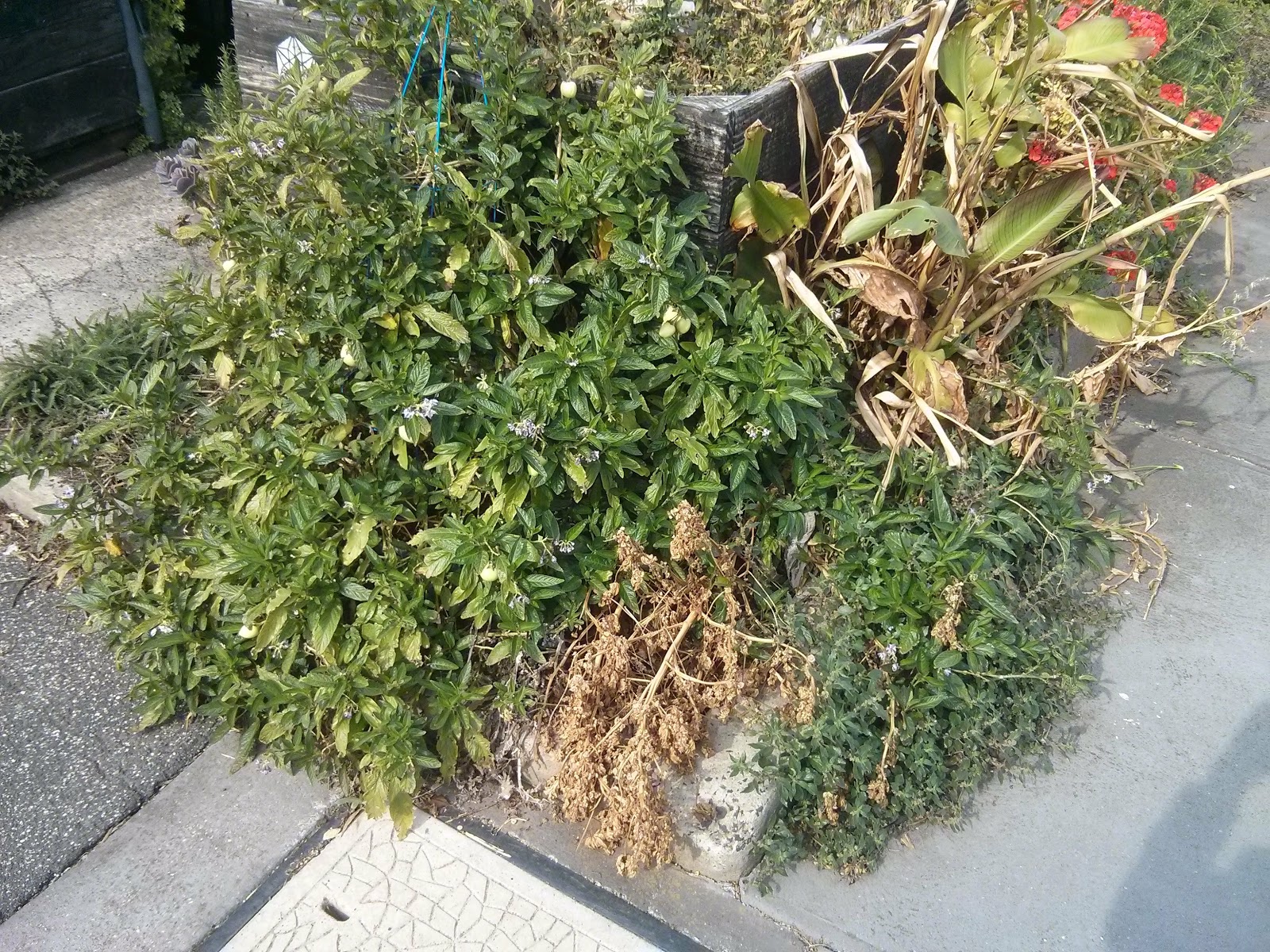
Gardens need tending, even if they have been set up with some permaculture ideas. The mild climate means that any spot which can grow something will be taken over by abundant weeds floating around. The rosemary, which survived probably already for a decade in the front yard. might need no help surviving, but besides this, things go pretty wild. The ivy growing along the fence to the neighbouring property will soon shade out everything beneath it, the passion flower is about to take over the pineapple sage, the ground covering succulent certainly stopped the comfrey from brandishing the abundance of purple flowers which attracted many bees last year.

While the patch isn't that big, it would take probably a day or two of pruning, weeding and mulching to get it back into a presentable and pleasant state. Of course, without caring about the more thirsty plants, a single intervention would probably just help for a month or so, but then, my time here is limited. And it seems like my former boss cares more about his social media image than the impression his place of business gives.

Feral and uncared


My offer to improve the first impression about his space were declined, mainly because of a ridiculous grief over my house mates dislike about the frequent use of the warehouse as entertainment place. A single one star review of his business sparked a conflict which nearly led to mutual intervention orders. While I did my best to remain neutral, I'm now blamed not for bringing my housos in line with his demands, and have to suffer from minor irrelevant consequences of his wrath.

The care about the real life impressions of a feral front yard reflects his care about the "community" he's trying to build. Being present and approachable in front of the warehouse meant that neighbours approached me, but not everybody in earshot of his enterprise is willing to show their dismay about the noise pollution coming from his space. At least not in person. After all, it takes some courage to rock up in the middle of a night to tell a bunch of pissed people that you'd like to have some peace and quiet late at night.

My housemate approached the ongoing noise pollution in a reasonable way, trying to engage the people in a face to face conversation and asking to tone it down. After some unpleasant (and later quite intimidating) responses, she decided to leave a one star rating with the comment: "Would give zero stars if possible." That's when things started to escalate, luckily not to the level of physical violence.

As a single review is obviously capable of single-handedly bringing down an entire business, my former boss knocked fiercer than police on our door, and took about a minute to lose his shit, demanding to remove this review, or else... We managed to ask him to leave and take his temper tantrum with him. As response, he used the A-board, often illegally (without council permit) placed on the pavement, to leave a message: "My neighbour doesn't like music and writes negative reviews on social media. He now gets a concert everyday until he deletes his review. Requests? @nameomittedcozYoucanresearchifyouwantto"

That happened about a month ago, and while I had some relatively normal conversations with him in the meantime, I noticed the grudge he still held today when offering some gardening services. I was surprised, mainly because I had no idea about the other social media stuff which happened since then. He complained bitterly on facebook about the uptight neighbours trying to limit his "right to party" whenever he wants to, and begged his abundant fb followers to leave positive reviews of his business.

I admit, as immediate neighbour I got sometimes annoyed by the random party noises coming from next door, and even while still working there, I sometimes called/texted asking to tone the noise down. In real life conversation, I suggested sound-proofing, as I was certain that our house couldn't be the only one affected. Which seemed an outrageous suggestion, because "all the neighbours love him, just our house causes trouble".

So when I checked out the google reviews again today, I couldn't help but revel in a bit of schadenfreude. When my housemate left her review, the company had maybe a dozen reviews, the oldest from 2 years ago. When I was working there, I served maybe about 100 people in person, dealing with 1,000s of mail orders. Most people didn't bother with a review, and I guess most people didn't check it to decide whether they would come or not.

Now it's a whopping 54 reviews, not even half as much as a Cafe in the same street which opened a couple of years ago. Unsurprisingly, most of them happened about a month ago, some of them explicitly referring about the nasty neighbours. Niall wrote: "Ignore all these 1 star reviews! **** **** ***** is the best! These immature bully boy tactics because a disgruntled man-baby doesn’t like live music! Wow! Support local, listen to loud music! And number 1 allways love! Not hate!" While he might have checked in this year, I haven't seen him in the neighbourhood for a long time, so I guess his, and his girl friends review reflect facebook solidarity.

Another item of this kind of solidarity: "These guys ran a fundraiser for my friends at their warehouse, and now the neighbour is getting their friends to write fake reviews? I rate that 0 out of 5, and the good people at **** **** 5 out of 5." Hmm. If I find someone offering their space for free to raise funds for a theme camp for a festival (remember, parties are totally sustainable and the best way to change the world for the better), and probably throws some free drinks in the mix, I would absolutely vouch for him.

As mentioned, part of the image of social engagement, and image building works out on social media. "Amazing ********. Wonderful social events. Proprietor is a real environmental activist and a generous kind-hearted gregarious human being" I don't know whether this poster is aware that the warehouse is in a residential area, without liquor license and not classified as entertainment venue. Many of the former, quite fast changing employees might disagree with "kind-hearted", but then, I'm biased.

"Social events" often need a lubricant, and bribing with free booze works like a charm. Yet even pubs are well aware that it's better to have their drunken patronage indoors after 10pm. Well, that doesn't apply to this warehouse, and so unwillingly listening to highly intellectual conversations of pretty pissed people often continued long after midnight.

Another commenter also has nothing but praises: "Great tasting ******** made ethically; solar powered and empty bottles can returned to place of purchase and will be reused.
Be dubious of negative reviews, as they may have ulterior motives."

While the bottles were indeed (illegally) reused up until about two or three years ago, this practice has stopped. Unlike the marketing for it. One of the reasons I stopped working in that place was the obvious discrepancy between what's on the label and what actually happens. Don't get me wrong, I appreciated the maverick approach to wash and reuse bottles, and private customers might still get a refund. But just like the front yard, the ethics have gone a bit feral.
Dying and disrespected

So let's have a look at the "ulterior motives" for negative reviews. In my naive view, community literally begins next door, in your immediate neighbourhood. Online communities, just like party communities, seem a bit vapid to me. They might sometimes offer similar benefits like real life communities. I'm totally willing to believe that, despite not having experienced it. Being the old fart I am, I dearly miss the social glue I experienced before the rise of mobile phones and social media.

What do actual neighbours of this company say? "Deplorable people who disturb the peace of neighbours due to “bad comments”. Don’t know how old the people who operate the place are but they need to grow up and not create a public nuisance of themselves in the neighbourhood". This surely sounds like someone having read the sign mentioned earlier. "Not very nice humans operating a business, you need to be able to work with the community not against it." Olivia certainly seems to have doubts about the "community building" aspect of this business.

Paul writes plain and simple "Respect your neighbors." Which just sounds to me like he lives close enough to have an opinion about the things happening in the warehouse. Greg leaves no doubt that he lives close to the place where beautiful social events happen. "About time people spoke up about these idiots, I have two young kids and live within ear shot of that place and for years we have had to listen to foul language and vile and degrading comments made to other people coming from that place, all while hiding inside that building. Don't know whether they have the mind set of a bunch of three year old's or if they really are a bit simple, most people in the area despise them and ignore/avoid them, there have been countless complaints made to both council and police about them over the years, sooner those supremacist are gone the better." (emphasis added by me)

I haven't met Greg, probably because he might associate me with the warehouse, and therefor ignores/avoids/despises me. No hard feelings, especially as he voices something I tried to communicate to my former boss for some years, without any success. However, it seems like even some random visitors have some doubts about the loving, beautiful people working in that warehouse... Stu writes: "Really friendly people as long as your not Black Asian or gay" and gets immediately backed up by Sally: "Well put Stu, I have heard some of the most derogatory comments directed at people coming from that place"

Just like the comfrey in the corner of the front yard, I guess I'm burned in the neighbourhood. I was visible a lot while I was working in the warehouse, tending for the front yard on a near daily basis. Most likely I will be associated with the nuisance it caused over the years to those "living within ear shot of that place". This attempt to settle down and engage with my neighbours didn't work out. Then again, I will have to move out soon anyway, without even knowing whether my strange situation will allow me to find a roof over my head at all.

The uncertainty about my future does my head in. I learned to appreciate gardening, hanging out with our shared pet, becoming local. I feel as connected to this place as I felt to the place I grew up in. I can only hope not to get as feral as the front yard garden I set up.

Thursday, January 23, 2014

The art of letting go

If I continue this craving 
for you, I'm only paving
myself a road to misery,
that ain't no mystery.

Instinctively, right from the start,
we connected deeply from the heart.
Soon our relation changed its kind,
and become a battle of the mind.

While I enjoyed our immersion
in soulful flow, it led to aversion.
Now, holding on to hopes in vain
will just manifest some more pain.

Whilst your ego runs the show
I can only let you go. 


Thursday, December 26, 2013

Sleepless night

Your life seems like a battle for control,
there's a fight against yourself inside -
you know that fight is just not right
and asked for help to become more whole.

We were mutually attracted,
and let our defences go
connected into effortless flow -
but very soon got distracted.

Control returned with a vengeance
and demanded plenty of distance.
The old ways came back and did much
to prevent more exposure to healing touch.

The door is still open, now you decide -
No jailbreak needed, want to step outside?


Wednesday, December 18, 2013

Liebeskummer

Our story was too good to be true -
if only I could stop loving you!
This torturing pain could go away
and my life would again seem okay.

You brought happiness back into my life,
I'd happily have chosen you as my wife.
I had millions of things for you to give,
'cos you gave me millions of reasons to live.

Now my heart feels empty and sad,
missing the special connection we had.
I'm way to numb to start to cry
I just know that I'm ready to die.

Our story was meant to last,
can't believe it ended so fast.


Wednesday, June 12, 2013

Rainy day in June

My future seems uncertain like never before,
and my brain and bones feel pretty sore.
I love myself just when hating me
so tired of the game of wait and see.

All of my ambitious aspiration
has turned into bouts of desperation
while I acquired much more unity
I lack the sense of community.

A single cell of a large organism
that drifts one more time into fascism
I wonder - am I cancer or cure?

But I never can be sure,
how to play the game of life,
for as long as I survive.

Wednesday, September 26, 2012

City ambassadors or pseudo police?

It took nearly an entire year to reconstruct Swanston Street, one of the most frequented bits of Melbourne's CBD. Most of the time, hardly anyone could be seen actually working on the reconstruction, and most passers-by were busy enough to squeeze through the narrow bits of pavement left for the pedestrian part of the population.

Unlike many European City centres, traffic is still allowed to pass through, not only Melbourne's iconic (privatised, over-aged and not build for capacity) trams, but cars can still make their way through as well. The planners came up with a solution for cyclists that only convinced car fans can conceive, having a bike path between the waiting area for tram passengers and the tram lines.

In good old Australian fascist fashion, markings on the pavement tell the pedestrian what they should do. The bike path is marked with dozens of 'KEEP CLEAR' stencils, large signs for cyclists order them to stop and let tram passengers pass at the four stations along the reconstructed area. As it takes a while to re-educate the population to a new set of rules, I take a lot of care while using the bike path on my unicycle, as it's often taken as convenient short cut to cross the road, or as waiting area despite the 'Keep clear' markings.

The latest station to be finished is in front of the RMIT, and many students have sufficient attention deficits to bumble into the bike path, which really doesn't bother me much, as I'm not too fast on the unicycle.

The architectural preference of Europe in the 80s dominated the station design: cool metal and glass, and strange blue lights potentially as tribute to the 21st century. I haven't waited in rainy conditions for a tram there, but I guess the idea of sheltering waiting passenger is meant rather symbolic than practical, like at many tram stops in Melbourne.

The benches, made of thin steel bars, are not only cold and uncomfortable, they are outright dangerous as I had to find out today. I got distracted on my way to one of them, and hit my knee against the side of a bench. Although I was moving in a rather slow pace, the sharp profile of the thin bars poking out at the side of it left a gashing wound. I guess many people will be injured by this stupid design, which ironically happened while I observed some activity most likely intended to increase the safety at the newly build stations.

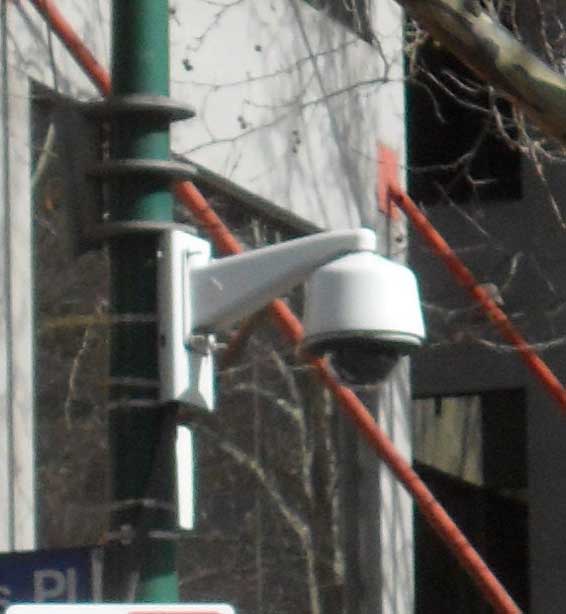
Melbourne has some volunteers acting as city ambassadors, wearing bright red shirts and caps, available usually to answer questions. They usually roam Swanston Street in pairs, the pair I asked about the spy cams at the intersection I met them didn't even know about their existence in first place. Unlike described on the city councils website, the cameras that look eerily similar to those that became more familiar after the reporting about Trapwire, there's no signage indicating their presence. As the MCC promotes the pervasive CCTV surveillance to increase the feeling of safety, I wonder how this can be achieved when hardly anyone notice them.

Today, however, two ambassadors approached cyclists and pedestrian who didn't follow the proper rules of making use of the redesigned tram stop in front of RMIT. When I saw them ganging up on a cyclist for rolling a bit along the tram, I tripped into the bench as I couldn't really believe what I saw.

I didn't even notice the bleeding until after I sat down - hitting your knees always hurts a lot, but this was the first time I ran into something that sliced the skin so easily. After telling the cyclist off, the ambassadors continued to have a watchful eye on everyone passing through their area of righteousness. The older one of them even walked after a guy in suit for 10 metres or so to inform him that he went on the 'wrong' part of the tram stop.

Give a man a uniform, and he turns into a fascist, drunk by power and self-importance. I wonder whether they acted out of their own idea to preserve law and order at the tram stop, or if the ambassadors are now trained to interfere with the dangerous elements of society that lack obedience to the writing on the pavement, and in an incredible act of defiance, walk on the bike path.

The most liveable city on this planet, now with power-tripping ambassadors, 'free' bikes that only cost a couple of dollars (not refundable), soon without single tickets for public transport, instead with a Myki that can be conveniently ordered and sent to your home for only $10 (non refundable). If you dare not to understand the PT ticketing system, gangs of ticket inspectors might detain you for a while, and after some weeks of using stations like Flinders Street or Melbourne central you will find your way around, and no longer complain about the lack of signs towards the platforms or the exit.

The zombie apocalypse has already begun, people leave their common sense at home because in public it's neither required nor appreciated. If you break the rules, someone in uniform will fine you so that sufficient memory traces for obedient behaviour are burned into your neurons. As neither Orwell nor Huxley got it 100% right, the mixture of 1984 and Brave New World is now normal Australian behaviour - distracted by sex and drugs, permanently surveilled and bossed around by people in uniform just following orders. Hooray!


Monday, August 20, 2012

Strolling through the most liveable city of 2012

I happily admit that I fell in love with Melbourne. Some of the weirder experiences I had here lately make me wonder whether the title of most liveable city on this planet really applies. If so, the planet must have turned into some really unpleasant place.
Collection of cameras in less than 5 minute walking distance around the main motive,
no duplicates, many omissions

Anyway, I went on a mission to investigate a little bit whether I could find some surveillance equipment that could fit into the #Trapwire technology. The internet research unveiled no direct links into Victoria, however, the government here committed to have stricken a deal with SAIC, another one of the global paranoia players providing the technological equipment for total population control.

Williams Str 91
On my way to the city I enjoyed some blue skies and a bit of sun, which I hadn't seen thanks to Melbourne winter for a while. The familiar sight of chemtrails made me aware that soon the sun would vanish behind some hazy clouds. I knew from Google Maps to look for a building with an ANZ branch in it, close to Collins Street, and soon I arrived at the building, inconspicuous like most of the farms for people in suits in this area.
Eagle House
While looking for the location of the Melbourne office on the web, I noticed that SAIC also has an office in Pine Gap, a well establish spy base close to Alice Spring, not mention being located in plenty of US military bases around the world. Some of the bases had strange names often with 'Eagle' somewhere in it. Not that I don't like eagles, but in a way it's interesting that this company shares their favorite animal with the Nazis.

Tenants of the Eagle House, (highlight by PS)

Although there weren't any current job adverts, SAIC had already spread out in this building to another floor. Varec Inc might be just another company belonging to the web of 'security' companies that like to use as many disguises to remain looking harmless, and warrant a high level of internal compartmentalisation.

Collins Street
Now that I knew my way to yet another place where millions, if not billions of taxpayers money is spend against the population, I continued to look around for some dome cameras as they are used for #trapwire. I didn't have to go far.
Collins Street again
Most intersections along Bourke Street had one dome camera, hidden in plain view as most people frequenting this area don't pay much attention to anything around them. The council might explain them as 'traffic' related, although they differ a lot from typical red-light or speed cameras.

ANZ Bourke Street
This scenic view however, doesn't show a traffic cam - unless you can break the law easily as pedestrian. It captures the entrance of the ANZ building, but basically has a splendid view along the pavement of Bourke Street.

Close up ANZ Bourke Street camera
Hmm. Looks exactly like some the cameras attached at intersections, and although it kind of blends into structure, it looks like being attached after the building was finished.

Parliament House Station
Now that's what I call a convenient location for a surveillance camera - directly at the entrance to a train station, and it seems to be the same kind of model as the one in front of ANZ.

Colourful stretch of Bourke Street
The upper part of Bourke Street has a lot of gastronomy, cosy little buildings framed by the skyscrapers in the background. Outdoor areas to have some food and drinks, meeting with friends, having a yarn, while someone might a great view into the cleavage of guests from above.

Close up from scenic Bourke Street view
Or, depending on the resolution of this camera, which can pan, tilt and zoom, you might even read laptop or mobile phone screens over the shoulder over the user, without raising suspicion with your smelly breath when this still had to be done in person.

Less scenic Bourke Street view
I admit, this photo doesn't really look good. It's as chaotic as a lot of the views in Melbourne's inner City, but maybe you can guess why I took it.

Close up less scenic Bourke Street view
Yet another one of those nicely shaped surveillance cameras, like many others not really planned to blend smoothly to its attachment, yet again nearly invisible due to its height. Basically another perv cam, in summer time many women working in offices show off their cleavage in their business customs, maybe that's one of the perks for the poor souls condemned to spy on their community.

Witty caption (forgot the location)
Okay, call me boring, there's a diversity of camera models in public, not only the dome type that looks so much like the photos I saw in some of the TrapWire stories. At some point, I noticed that especially ANZ branches had cameras directed on the public, but hey, I'm sure it's a coincidence that SAIC has its office in a building shared with ANZ. And claiming that jumbling the letters and adding an I makes ANZ Nazi would totally undermine any credibility to this story, so I don't.

Obviously corner Bourke and Swanston Street
I didn't follow Bourke Street further down south, depending on some more sunshine with less chemtrails I might do this. I wouldn't even be surprised to find less of them, because of the strategic importance of this specific stretch of the city. Most rallies held in the CBD start at the State Library, go down Swanston Street, turn onto Bourke Street up to the Parliament.

Corner Swanston and La Trobe Street, opposite State Library
When Eastern Germany disintegrated, and the files of the Stasi (GDR's secret service) became public, many were shocked to find out that the Stasi was able to track people in East Berlin's centre completely just with surveillance cameras. Not to mention that even toilets had some, just like the idea of contemporary shop owners to have cameras in changing rooms.

TrapWire cam (via rt.com)
Go ahead, coincidence theorists, explain it all as harmless, unimportant or 'conspiracy'. Or maybe someone get issue an FOI to the Melbourne Council, asking for the purpose of the cameras, the money spend on it, the people operating and watching.

The TrapWire story seems to make the Empire nervous, lots of things happened to distract the overly short attention span of average citizens. The trolls on chats eagerly dismissing the importance of Trapwire were of course not at all PsyOp. I mean, the government wouldn't really spend money on engaging in social media, using similar strategies to viral marketing to whitewash their curiosity about every step we take in public.

Monday, April 16, 2012

Occupied world


The last battle has just begun,
the lost battle cannot be won,
an endless fight to the death,
until the very last breath.

If we kill what we don't know,
we'll miss the best of the show -
what our hearts are yearning
are healthy steps of learning.

So for an exciting start
learn to open your heart
and let it speak through you.

Don't try too hard,
don't be too smart
and you'll know the next thing to do.


Sunday, March 11, 2012

Violet Skies

The concrete sky deflected the rockets,
brought light into the tunnel's middle,
just like a reversed ancient riddle
with eyeballs bouncing in their sockets.

A wall of smoke enveloped all
light beams piercing the veil,
an occult quest for the holy grail,
united in this strange hidden hall.

The sound of the underground,
echoing, reverberating, oscillating,
synchronising and liberating,
in a cosmic game of lost and found.

I savoured breathing some fresh air
after leaving this special vanity fair.

Monday, December 12, 2011

Evolutionary creation myth

The planet asks for help. Lady Gaia fell sick, because a tiny part of mankind turned us into the greediest species nourished by her. Good news: The species that threatens Lady Gaia can also save her. If we walk together to help her, mankind as a whole can stop the madness of the global corporate state that grew into a psychopathic killer. The next step of evolution requires us to relinquish ownership of this planet and return to our function as custodians for the eco-systems we utilise, and the planet as whole.
Phase 0: The need for to care for every human being remains unanswered by the systems of society in control of the resources of planet. The abundance of this planet combined with accumulated knowledge is applied to fulfil egoistic wants of a tiny minority disconnected from the source of life.

Planning, Phase 1: Fire. It's time to act, this consciousness serves as inspiration and motivation for taking action to stop the system.

Presence, Phase 2: Earth. Fire creates Earth, the occupation as materialisation of the beginning of the resistance emanates.

Process, Phase 3: Metal. Communication and interaction forge the primary tools of the occupation: Respect, love and non-violence.

People, Phase 4: Water. Tools need an operator. Cooperation among different skills and backgrounds allows the application of these tools. All those tuned into the ego-less flow.

Products, Phase 5: Wood. Applied knowledge nurtures the products of the occupation, projects, direct action, physical structures, work groups, art, care and healing.

The lived experience feeds back into Phase 1, for further refinement.

Simultaneously, the phases counteract (control, destroy) each other.

Fire melts Metal. Our imagination limits the tools we specifically use. If fear motivates us, our tools will be blunt, love creates the nurturance to grow a balanced system.

Metal cuts Wood. When we apply we wrong set of tools, our projects will not contribute to growth.

Wood restricts Earth. What people can see of the occupation depends on the projects happening and materialising.

Earth dams Water. Although the organism 'occupation' can exist in separation, it wants to live in community and open space. It thrives by immediate interaction.

Water extinguishes Fire. Without cooperation, the inspiration remains limited. The diversity provides the wealth of ideas from which to harvest the best solution for the next challenge.

As super-organism, all phases are active in any moment, in different balances in each cell (ie occupier). The more balanced and aware about their function individual cells become, the more balanced the occupation as a whole can grow.

We're nurturing a global brain to heal Lady Gaia, we better become familiar with sustainable approaches to describe and think about life. OM lived through many cycles of this ancient map of life, and has already shown resilience to adversity. The antibiotic of a corporate regime failed, we already mutate fast. Evolution goes on, and it's increasing in speed.

Thursday, October 20, 2011

Sprouting seeds


Day 6 of the New Era of Humanity shows positive signs. Non-violent resistance appears in dead-end situations, usually without much more than the call for justice and equality.

The failure of the systems of society to provide justice and equality became overtly apparent after the so-called Global Financial Crisis. However, it remains mainly a question of believe whether you trust in the current systems of society to fulfil a useful functions, or not.

Obviously, the occupants can't answer this question either. Politics finds its justification by spreading fear, uncertainty and doubt. Politicians stopped promising a brighter future, they just promise to prevent everything not to get worse. And no matter how much worse any local situation gets, they can point the finger at some other country where it's much, much, mucho-macho more worse.

At the moment, there are some 'talking points' which could be understood as 'demands'. Transparency in politics, abolishment of the legal status as 'person' for corporations. Basically, it's is a re-negotiation of power structures on a global scale.

Finding consent in a large, diverse group proves difficult. Finding a common ground means a simplification of the rules in order to allow them to be flexible. So far, 'common ground' was rather enforced by law - in Victoria public swearing can be fined on the spot.

In an interesting chat with Dillon I heard some concerns about the penalising system. How should aberrant behaviour be dealt with, don't we have a 'natural need' to be policed. Yet even with an abundance of legislation defining what a society considers 'legal' or 'illegal', crime occurs as exemption from the average daily life.

Unless, of course, the crime is institutionalised. The cops beating up occupants 'just did their jobs', protecting an outdated system violently. Historically, police got away with a lot of violence, although Australian police won't get the nomination of the Biggest Beater in Uniform for October's reality-internet coverage of global affairs.

I hope the Melbourne police doesn't change their ambitions to make Melbourne 'Queen-friendly'. The royal wedding in London showed the disrespect for democracy quite clearly. I don't mind so-called royal families providing some spectacle for their fans. But they still can force everyone to finance their follies, not only those you wish to support them.

I consider human beings generally quite supportive. Especially Australia lives to an amazingly large extend its stereotype to 'give generously for a good cause'. I can even discover something positive in the outrage about free-loaders, I simply disagree about who the 'free-loaders' are.

An escalation of violence would only attract more people to join this peaceful way to resist to be transformed into a piece of corporately owned life-stock. The internet helps to bring abuse of power into the public sphere, and undecided citizens can judge for themselves whether they want to pay with their taxes for a violent and oppressive government in bed with the corporate world, or whether to find new systems of cooperation to organise co-existence of 7 billion people in peaceful ways.

Thursday, September 08, 2011


The time-binding capacity or energy of man (no matter what time is—if it is), which is unique to man, is a most subtle complex; it is the highest known energy and probably has many subdivisions. Ears are sensitive to the vibration of the air. Eyes are sensitive to the more subtle vibrations of light; in a similar way, the time-binding apparatus is sensitive to the most subtle energies; besides which it has the capacity to register not only all of our sensations but also the time-binding energies of other people; and it apparently has the capacity to register the energies of the universe.

Friday, April 29, 2011

Intelligent life in the universe


Sometimes, life seems like a never-ending puzzle, with millions of pieces, ever changing and never completing. The missing pieces of the puzzle only open up the next level of experience, and hardly ever lead to insights into tidbits of truth worth memorising in stone.

Yet, some artefacts made of stone survived millennia to tell us about the human past. Carving stone takes more time, skill and effort than writing a blog entry, yet in comparison to the latter, has proven more reliable to survive the changing tides of human evolution.

Our current civilisation, emerged and shaped by the childhood of humanity, might leave its legacy with the Georgia Guidestones, lots of plastic and radioactivity. The net as living, collective historian of the evolution of mankind might not survive as long as the Sphinx or smaller morsels of information cast in stone.

The collective mind of today seems rather insane - not hopelessly and incurably insane, yet more and more dangerously insane. Human curiosity doesn't stop to ask about its origin, its heritage. The myth provided by the consensual reality of (western) societies might contribute to this collective confusion.

Science currently dominates the myth making game in the Western World, yet the revolutions in scientific thinking of the 20st century haven't been transferred into the common meme pool. Let's shortly wrap the scientific narrative about the origin of man.

About 14 billion years the Big Bang happened, with really strange things happening in the very first few moments (a second or so), until all matter drifted away from each other, shaping stars, planets, galaxies and so on. The chemical elements we know of were created by fusing hydrogene, stars breed all the stuff we see around us. Due to our metabolism every atom in our body will be replaced within about seven years, we are literally made of star dust.

According to contemporary scientific belief, chemical 'life' differs drastically from human life (and I totally agree). However, the clay humans animate, has a long story attached to it, actually an extra-terrestial story. It might blunt Occam's razor a bit to prefer the complex cosmology with Big Bang and all, and disregard God's six day job of creating the universe 6000 years ago, but then, I'm convinced by the evidence presented in favour of this ancient, maybe even rusty universe.

Wikipedia states the age of our planet as four and half billion years, so each and every atom found on this planet had spend already billions of years floating though space before ending up in human bodies, cars, computers and pizza. Earth started off very hot-tempered, a bubbly metal core spew various elements onto a slowly solidifying crust.

During this time, this planet got hit by a large celestial object, and lost some of its mass to give birth to the moon. The continuing volcanic activity build the foundation for an atmosphere, the impact of other objects made of ice most likely contributed to the abundance of water we still enjoy today.

When life started exactly remains unknown, somewhere between 2.5 and 4 billion years ago. It developed in the ocean surrounding Pangaea, the massive single continent that broke up about 250 million years ago. Humans or their ancestors missed out on this super-continent, and made their appearance between 1.5 to 6 million years ago. For at least a million years or so, hairless, upright walking members of human family know how to control fire, inventing their own ways to transform energy.

Homo sapiens sapiens, the name given to the current evolutionary phenotype of time-binding humans, exists for about 200,000 years, according to Wikipedia 'history proper' began about 8000 years ago in the region known as 'Middle East'. My head buzzes with all the numbers, especially when I attempt to bring our 'knowledge' about the universe and mankind into a consistent picture.

We distinguish different species by their genetic outfit, and all humans share a similar DNA structure. Homo sapiens sapiens has shared this planet with other human species, another bit of evidence pointing to evolution as law of nature. The methods to look back into time we have at the moment have limits, as organic material deteriorates usually very fast.

Cultural forms to transmit historical information let us stitch back a sketchy picture of something like the last two millennia, yet merely a couple of hundred years with more reliability and credibility. Although the principle of 'scientific objectivity' never dominated among any documented society, we assume that historic scribes did exactly act like this, and reported 'truthfully' about the events around them.

I tend to believe that signal/noise ratio of 'historical' information goes along a Bell-curve, and any source needs a healthy dose of skepticism. Veracity seems of little importance in mass media reporting, and facts rarely make headlines. The field of history represent rather a story collecting than a fact detecting human endeavour. The diversity of explanations around the events of September 11 2001 typifies the amount of story-telling emerging after an cataclysmic event.

We can hardly claim to know for sure what happened in the last ten years, so speculations about events spanning hundreds or even billions of years back can't be considered as facts. Written history, the way we understand it in 2011, only captures a tiny aspect of the adaptions of evolution the human race experienced so far. Yet any group of people has oral traditions telling about their origins.

Many of these creation myths vanished from memepool, many others survived in different shape and forms. As we 'know' the true story, Big Bang and all, studying those old stories can't provide any more useful parts connecting to the puzzle of human existence. All this talking about Gods obviously indicates a naive, pre-civilised concept of reality.

Yet some facts from the past remain unexplained. Many civilisation mastered technology in ways we can't explain or recreate with today's methods. The pyramids demonstrate amazing engineering skills thousands of years before the advent of the computer, which nowadays assists the construction of awe-inspiring mega-structures.

One explanation given for some marvels of the past includes extraterrestrial visitors. Do aliens exist?

I don't know. Yet many stories about aliens exist, and some of them quite old. A friend made me curious by talking repeatedly about UFOs, and so I went on a quest to find out more. I was told an eyewitness account of a sighting, and had a distant sighting myself some time later, but hadn't bothered investigating this phenomenon in the collective story pool of the WWW.

From a scientific point of view, the existence of life outside our tiny planet has a high probability. Astronomers have begun identifying solar systems with planets, and the sheer number of the billions of galaxies with billions of stars indicate how little we really know about our universe. We love the metaphor of the needle in haystake, yet the needle Gaia hides in the haystake Milkyway, which makes finding life elsewhere tricky.

Contemporary science has little ideas how to explain interplanetary travel, and shows little interest in considering visits from outer space. The level of xenophobia seems rampant in the 21st century, and if someone won't open their heart to an 'alien' member of their own species, they would hardly welcome visitors from other planets.

And when in doubt, ask Hollywood. The majority of movies warns about dangerous aliens, so we better avoid hoping for their arrival. Just like the real existing US empire they will invade this planet mercilessly to destroy infrastructure, rob resources and enslave us. Hmm, sounds like the evil aliens have already won the battle, but let's rewind for a second.

Humanity hardly tipped its toes into the ocean of the Milky Way, so swimming like a dolphin in it to master interplanetary travel requires some advanced technology. Mankind brought much suffering among itself by using technology for military purposes. The childhood of humanity looks cruel, bloody, savage from a conscious point of view. Technology fuelled the game of war, trying to establish fear into the nature of the human race.

Anyway, it's too late to be afraid, it seems like the aliens have already reached us. Unless they control the  33 bloodlines running the economic matrix of this planet, they seem to be friendly. Otherwise, the gap in technology should have seen this planet obliterated easily, according to Buzz Aldrin.

More thoughts on this topic will come. Wouldn't it be a great PR stunt if some UFOs hovered over the royal wedding today? A bigger life audience can hardly be reached soon....

Saturday, January 08, 2011


A zen student once asked his teacher Ikkyu, a fifteenth century Zen master, to sum up the highest wisdom. The master responded to this enormous question with a single word scratched in the sand: "Attention."
The student wasn't satisfied and asked him to elaborate.  Ikkyu wrote: "Attention. Attention. Attention."

Friday, December 17, 2010

History in the making


The only thing human beings know for sure is their own history, at least if you follow along the ideas of Giambattista Vico. History needs the luxury of culture, a feature of humanity reinvented in many parts of the planet for millennia. The roots of civilisation date further and further back. Each of them deployed our inventive consciousness to create technological progress and an increase of available resources for their inhabitants.

Until lately, civilisations barely had the means to cooperate on larger scales. Few decided over the fate of many, creating the mess we witness today. Profit-driven wars rage, profit-driven paranoia sells stupid security measures, and thousands starve daily on this planet that can feed every human being. When natural disasters devastated the livelihoods of other people, a global wave of helpers emerge. Statistically, there are much more people willing to help than those who want to harm, society functions only by cooperation. 

History does not contain 'facts', merely narratives. September 1st 1939 does not tell us anything about the chains of connections and events that led to the second World War. We can learn about patsies, false-flag operation and propaganda that typically appear as side-effect in preparation for pre-emptive warfare by investigating the memetic structure of the surviving artefacts of any given period of the past. History taught in schools and universities serves only as propaganda to protect the inane power structures governing the majority of people against their best interests. 

Now we don't need to watch any BBC documentary about WW2 anymore to understand how governments operate to make money out of war and violence. We can witness the conspiration happening with international diplomacy wikileaking into the public domain. It's no longer a conspiracy that governments conspire behind the back of their citizens, it's happening right here and right now on this very planet.

Democracy can not just base on trust into its representatives. Democracy needs transparency up to the highest levels. Whenever 'secret' documents from the distant past were unveiled, abuses of power became known. Each government comments fast that these wrong-doings are a thing of the past. In the light of wikileaks the continuity of nefarious activities of democratically elected governments becomes obvious. Control of government failed until now, only a truly open government suits democracy.

Wikileaks has provided a glimpse of transparency, so we can experience history in the making. Its founder Julian Assange made himself the target of malevolent governments, and the empire strikes back.  Charged with dubios allegations, chased by police throughout Europe, held for a couple of days in isolation, Assange walks in the steps of Rosa Parks. 

On a very short term notice, you might want to join the rally in Melbourne today 5:30 pm at the State Library. Let's document history in making from as many perspectives as possible, to prevent state propaganda ruining our minds.


Tuesday, November 02, 2010

Evolution and human history

We live in amazing times, and always have. The basic need for food and shelter exists for as long as humans roam this planet. Even in the 'modern' world with all its technological complexity and vast knowledge mankind hasn't conquered this challenge sustainably, not because it cannot be done but because  of insanity.

Human memes spread wider and faster than those of any other species known to us. Our story telling ability provides the basis for progress, an evolutionary phenomenon that creates dynamically balanced complex systems.  Contemporary science and craft still hasn't been able to recreate technological marvels of the human past, and the ideas of how people lived in previous eras of history often base on sketchy evidence.

As social beings, survival of humanity depended rather on an evolution of group organisation strategies than advancing the bio-physical machinery of individuals. Different environments favoured different strategies of how people live together, cultural exchange added into the mix. One might question the meaning of his/her individual existence, but the group with its customs, rules, traditions and myths seems to make sense, as it seems to last longer than any of its individual members.

When ever more people live together in smaller spaces, when ever urban culture emerges, art and technology advance, yet not in a linear fashion. Complexity of society adds to its vulnerability, especially the way it generates and uses energy. Deforestation killed many cultures, and the current wars in Afghanistan and Iraq secure the US future oil-based energy demands. The lack of sustainability and efficiency of a fossil-fuel economy is known already at least since Buckminster Fuller. Investing the resources in securing a useless mode of operation instead of devising more sustainable solutions appears to me utterly insane.

I can imagine the better-off part of society marvelling about the technological wonders and wondering about the future ahead of them in most times of history. With the need for food and shelter satisfied, story telling becomes the main occupation of humans. Humans devised amazing ways to utilize the resources of their environment, and many ideas spread around the globe.

A progressive society provides change much faster than the seasons that determined the life of many of our ancestors. Travel and communication technology have advanced like never before in known history, yet the structure of the mixed global societies looks similar to those in times of mass self-destruction.

The amount of people that could communicate together found its limits in societal, cultural and foremost spatial barriers. That limits the amount of ideas to choose from, 'best practice' simply meant doing anything in a way that worked somehow. Funny enough, Victoria's desalination plans seems as if the deciders never considered solutions from other parts of the globe, instead they use a strategy that doomed many societies.

The way evolution is taught and commonly portrayed unfortunately rather obscures evolutionary principles than allows us to take a bit more active part in it. It makes a lot of sense to consider developments in technology and society from an evolutionary perspective, and this makes it so much easier to perceive evolution as an ongoing instead of a relatively finished process.

Societies have always organised themselves, yet mostly only a minority within society acted as agents of this process of self-organisation. It doesn't really matter that not all ideas to structure society had something original to them. The diversity of concurrently existing and past societies simply indicated the lack of a 'natural' law about how conscious individuals organise their common affairs. Those indigenous cultures that survived until today lasted for much longer than any specific 'nation' or 'society', and proved thereby that mankind can survive without 'civilisation'. I have a good laugh at the idea that something as virtual and malleable as 'culture' can be deemed 'unchangeable', yet many fundamentalists might get angry about my bout of humour.

The 'us versus them' meme comes with the myth of any nation, and many other gangs of humans. It survived easier and longer than any technological advancement that could provide for the essential human needs. Mankind created technology to extinguish the entire species, and as a trade-off developed amazing life-saving technology.

Evolution seems to favour the 'us and them' idea. No species exists in isolation, only bacteria might happily survive on a purely an-organic diet. Ecology taught us to consider life more from a system perspective, and to study the interaction and interrelation of all species existing in a biotop. Have we cultivated plants and animals, or have these species adapted to us to selfishly spread their own genes around the globe?

Nature doesn't need humans to sustain life, it existed before and will exist after our species' expiry. The special role of humans on this planet, a meme popular with scientists, philosophers, artists and priests alike, has no basis in our current understanding of evolution. Wait, humans can master evolution of non-biological systems, and even their own, but as yet this meme hasn't reached many members of our species.

No society managed to 'stay on the top' throughout history, yet many still try. No strategy to organise society won the 'battle of civilisations'. Many species got extinct, yet the number of evolutionary winners  exceeds most peoples imagination. The evolution of ideas about the organisation of society show the same random variety as any experimental setup in the lab of life.

In an era of global travel and communication violent government doesn't make any sense anymore. Simple birth proves the evolutionary right to exist, no matter how hard bureaucracy may try to withdraw the means of survival for unwanted human beings. If everybody would want to live a meaningless and parasitic life like most professional scaremongers do, our planet would run out of resources within a very short amount of time. While violent governments needs individuals who combine greed, gullibility and recklessness, a sane society would rather offer those misguided individuals treatment than permit them to run the show.

Yet the Western World, conditioned to believe in the myth of enlightenment, shows little interest in a sane society. Although having power and acting responsibly are not mutually exclusive, without scrutiny representatives of government have always abused power. Most of the corrupt and irresponsible activity remains hidden under the cloak of 'national security' or 'public private partnership'. Corruption remains a much too successful business meme to undergo moral considerations. Corruption among politicians protects this mechanism from the law and public eye.

The way any society evolved doesn't represent any precipice, at least as far as I know. That doesn't stop politicos maintaining the myth to represent the best of societies by exclusion (claiming other societies offer less), This makes as much sense as saying because kangaroos have conquered Australia, all marsupials should be roos. Understanding that any living system (and I consider memes as living systems as well) evolves together with its environment means embracing diversity instead of enforcing conformity.

Any society defends some of its behaviour rules vigorously, while other behaviours are happily tolerated. It's okay in many western nations to show murderers and killings as part of story telling, yet real dead people are hardly seen. Unlike in Thailand, where graphic images of crime victims embellish the front pages of news papers. All groups of people developed some idiosyncratic ways of dealing with sex and death, deriving many other rules in accordance to this attitude to these essentials of life.

Again, the diversity of rules merely shows evolution in action. Progress seems like a by-product of the evolution of consciousness, and the consequences often favor only a minority of the human species. Yet progress as it manifests today would allow to feed and shelter every human being on this planet, if the splintered global societies wanted to. This doesn't imply some sort of welfare planet at all - yet the global free riders (politicians) like to perpetrate the myth that wealth leads to procrastination and decadence. Indeed, any society with considerable wealth and without control over their leaders ended in catastrophe or revolution. Violent government breeds intolerance, war, terrorism, murder, abuse, addiction and desperation.

Unfortunately, other forms of government hardly make it into the public consciousness as they can easily fall victim to the expansion lust of violent governments.  In retrospect, Saddam's Iraq before 1991 looks far more tolerant and secular than the US or Australia today, although dissidents held as political prisoners might survive longer with Western-style torture and imprisonment. Like after WW2, the US simply adapted the inhumane treatment of other people as demonstrated by the evil regime that got replaced. Of course, known wars hardly ever involved non-violent governments. Iraq just serves as example that comparing society standards can yield surprising results, and unveils the hypocrisy of fingerpointing, especially from the US government.

Rebranding war as insanity poses a huge challenge. From a global perspective, war creates losses by its unsustainable nature. Mankind needs protection, but not from our evil neighbours, mankind needs to protect itself from violent governments. Mankind shares one planet, and if mankind is willing to use evolution in its favour towards a more compassionate world it needs to cooperate to create sane forms of government.

Modern history creates the illusion of a relative linear development of mankind. The chaotic co-existence of different approaches of living together seems to scare those who live off collective fears. In the history of evolution diversity proved as advantage, and many forms of life simply vanished. The meme of violent government seems obsolete, yet still irresistible for many. And while it's popular not to expect 'historic' changes within one's lifetime, I have witnessed too many to lose my hope to see a much more just and compassionate planet than we have right now.


created at TagCrowd.com


Saturday, September 11, 2010

A memorial of madness

The mass trauma induced by the events of September 11th 2001 still linger untransformed in the global human consciousness. 3000 people were killed on that day, more than this number died as a consequence of the irresponsible exposure to the toxic aftermath of the collapse of three WTC buildings, more than 4000 American soldiers died since then in Iraq and Afghanistan, and hundred thousands if not millions of civilians in Iraq, Pakistan, Yemen and Afghanistan have been killed.

The global development since that event seems familiar and new at the same time. Utter violence replaced diplomacy, creating a boom for the prison and war industry. A Global Financial Crisis was created to redistribute more tax payers money to subsidise human destruction. Many grass roots movements emerged around the 'truth of 911', and millions of hours of mass media coverage hammered the official narrative into the minds of peripherally interested people.

Although it seems impossible to merge the factoids assumed about this event into a consistent image, and the 'truth about 911' might remain hidden, we could learn a lot about the way we interactively create reality. Diversity of opinion, a hallmark of healthy democracies, contradicts 'Political correctness' for certain topics. 'Believers' of the wrong story can only be lunatics, nothing from their mouths worth a second thought.

Most, if not all, societies use ostracism as punishment for perceived unacceptable deviation from the myth that maintains a society. Besides the senseless destruction of lives in the war zones, many people in the warmongering democracies lost their jobs. What happened to Dr. David Kelly might appear in the files of the muscle of Organised Crime better known as Military Intelligence.

A staggering amount of resources have been destroyed to 'bring freedom and democracy' to some countries, while social systems and civil rights in the war faring countries deteriorated. A great deal of focus of governments in the western world lies on the paranoia about 'terror' to the expense of life supporting principles.

No matter who is responsible for the immediate victims of the events on 911, the US government brought havoc and death to the people of Afghanistan, Iraq, Pakistan and Yemen since 2001. If a nation reacts with a vendetta against their perceived illicit controllers of valuable resources, its behaviour can neither be called rational nor humane nor civilised.

The events on 911 brought suffering to many, yet the insane reaction to this dreadful event initiated a bloody cycle of violence with no end in sight. Violence breeds only more violence, and any reasonable acting agent can learn this truism from history. Yet the structure of government allows just for limited adaption of strategies, as it is based on the idea of the demonstration of strength against 'the others'.

The narratives of our global pop culture show the essence of this principles since Orson Wells' 'War of the world' radio show. No matter how bad the situation in the certain circumstances seem, once the aliens have taken over civil life ends. An experience shared nowadays in many regions of the world, be it Gaza, Iraq, Afghanistan or Pakistan. And a reminder to the citizens of warmongering nations of the 'greater good' in using life-sustaining resources to destroy human life, culture and sources of food and income.

So let's remember 911 as the day that unveiled that existing democracies base on the business model of the military industrial complex, and not on the 'voice of the people'. As long as our planet divides the responsibility for sharing its resources among more than 100 unaccountable 'leaders', violence seems inevitable.

War as solution for negotiation problems seems as modern as blood-letting as one all cure. More of the same leads to fatal consequences. In medicine, the folly of this well meant cure could not remain undetected, in politics paradigms shift very slow. I honour each human life, that's why I favour healing after suffering, not spreading more of the same.

Well intended death and suffering can no longer be hidden under the carpet of national security - history converts from the domain from creating useful narratives by a chosen few to accessing the subjective treasure trough of eye witnesses and opinionated observers on the internet. Monolithic myths of 'official' versions fragment into a kaleidoscope of perspectives to create idiosyncratic approaches to remedy the collective trauma induced by 911.

Violence can not heal, revenge only creates a vicious cycle. Nobody attacked the civilised world on 911, history has yet to see a civilised mankind on this planet. Which might just happen during our very lifetimes.


created at TagCrowd.com